Author Archives: peachandbones

India!

We’ve finally made our way to India. It’s been on our list of places to visit for quite a while, and now we’re here. We arrived on December 8th in Kolkata (Calcutta) after traveling for a few weeks in Thailand. There was no specific reason for choosing Kolkata as our starting point, other than the fact that Air Asia flies from Bangkok, Thailand to either Kolkata or Chennai. After some quick online research, Kolkata won. So, this posting is all about Kolkata.

One of the Hindu statues at the India Museum in Kolkata.

Hindu statue on display at the India Museum in Kolkata.

The experience of India actually started before we even arrived, and even before we left Thailand. The flight from Thailand to India included mostly Indians on the flight, which is to be expected. And with them came a bit of the Indian culture. As is commonly known, India has a large population, about 1.2 billion people. And in many places the population density is very high. According to the 2011 census, the population density of Kolkata was around 69,000 people per square mile. For comparison, in 2011, New York City had a population density of around 27,000 people per square mile and Boston was around 12,750 people per square mile. We’ve come to realize that this density can create competition for space.

This competition for space appeared on our fight to Kolkata. As soon as it was announced that boarding of the plane would begin, people dashed to the doorway leading to the buses that were to take us to the airplane parked elsewhere. Now, out of fairness, this happens at airports in the U.S. and other places we’ve traveled, though, to a lesser degree. People were jockeying for position, cutting the line, and there was a general sense of panic and anxiety in the air. It was clear that the folks at Air Asia on this particular flight were used to this and sent people away from the front of the line. At which point they cut in other sections of the line.

Passports and Visas had to be checked, so the line moved at a little slower than the boarding of most flights, but still a totally acceptable pace. As we waited in line, a couple of men directly behind us were outwardly troubled by the slow pace of the line. They were moving side to side trying to catch a glimpse of the front of the line, maybe trying to figure out what was taking so long. They sighed anxiously every 15 seconds or so, while bumping into my and Sarah’s backpacks almost constantly. Other travelers we met before India warned us that line cutting was common place in India and that you had to hold your ground in order not to lose your place in line. So Sarah and I gave gentle, yet obvious nudges backwards to make them aware of their encroachment.

Throughout the ordeal we couldn’t help but laugh out loud. Once I had reached the front of the line one of the two men made a last ditch effort to make it to the front of a second line parallel to ours. He was quickly rejected and sent back to his place in the other line. I finally asked the men what they were worried about and commented that the plane wasn’t going to leave without us and the 40 other people still waiting in line behind us. One of the men chuckled because he knew it to be true, yet, their anxiety persisted.

After our visas and passports were checked we boarded the buses that would transport us to the airplane. The frantic atmosphere was present there as well. People refused to give up their positions closest to the door, making it hard for others to enter the bus and make their way to empty space. Once the bus reached the airplane, everyone hurried to the side of the bus that was closest to the stairs leading to the entrance of the plane. The doors opened and people squeezed their way through and  then wedged themselves in front of others at the bottom of the stairs. There was still more jockeying for position on the stairs. Sarah and I got a little joy out of creating a human barrier, blocking anyone from passing us.

Once we were on the plane it became apparent why there was so much competition for line placement. Many of the passengers had purchased duty free items and wanted to ensure they had a place in the overhead storage compartments. There was a small group of men that had far more bags than was allowed and took up more overhead compartment space than you’re supposed to. Even without the fight for luggage space, many people had a hurried pace for no apparent reason. All the while, the flight attendants were clearly frustrated, and at times appeared to take their frustrations out by aggressively jamming luggage into the overhead compartments. Luckily, we found space for our bags near our seats, though, not above our seats where they’re supposed to go.

And that was our introduction to India.

After arriving at the Kolkata airport, we had to take a taxi to a hotel we picked out of the guidebook. We were told by a security guard that there were metered taxis outside. So we tracked down a taxi driver who claimed he had a meter. I was skeptical from the get go and once arriving at his car refused to enter until he showed me the meter. He pointed to a very old analogue gauge of some sort, clearly not resembling any kind of meter for tracking the cost of fare. So I said to him, “that’s not a meter”, to which we agreed and then quoted us a ridiculously high fare, 850 Rupees ($16). I’d read on a recent trip adviser posting that the fare should run around 220 Rupees ($4). So we walked away from his cab as he tried to negotiate price, all the while refusing his still too high quotes. The same trip adviser posting mentioned that there was a prepaid taxi. So we walked, carrying our large and small backpacks, surrounded by 5-8 taxi drivers all vying for our business until we found the prepaid taxi booth. We paid the 250 Rupee rate and finally got a taxi to the hotel.

The hotel we stayed at appeared to be a building from the British colonial era. It had an old style lift and a nice classic feel to it. There were bell boys on every floor, always trying to find a way to serve you. We’d read about this ahead of time and always politely told them “no thanks”. They were eager to serve solely in an attempt to receive a tip. We’re budget travelers, so tipping is something we avoid when at all possible. The room we stayed in cost enough, so paying for a service we didn’t want was not going to happen.

The old style lift in the hotel.
The old style lift in the hotel.

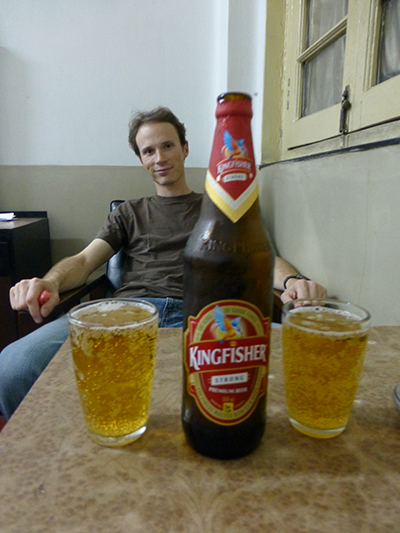
It's become a custom to have a beer our first night in a new place.

It’s become a custom to have a beer our first night in a new place.

The room at Hotel Broadway we stayed in.

The room at Hotel Broadway we stayed in.

Our first official meal in India. We started off with Pakora (deep fried veggies). Yum!

Our first official meal in India. We started off with Pakora (deep fried veggies). Yum!

We soon found out that bell boys weren’t the only people wanting money. We were either asked for money directly, or given a service we didn’t want and then asked for money, somewhere in the range of 40-50 times during our three days in Kolkata. Some of these were vendors that approached us in the street asking us to visit their “shop”. The conversation always starts with “where are you from?”. Unfortunately, we’ve had to resort to outwardly saying to people after hearing this question, “we don’t want anything”. So far, this only seems to be a problem in areas that tourists frequent.

Our first night out we walked from our hotel to the tourist area near Sudder St and Park St. We threw ourselves head first into the sea of people and the madness of the street traffic. Crossing the streets in Kolkata was the most challenging and scariest we’ve experienced so far. The best tactic is to join others in a critical mass until you can block the flow of traffic.

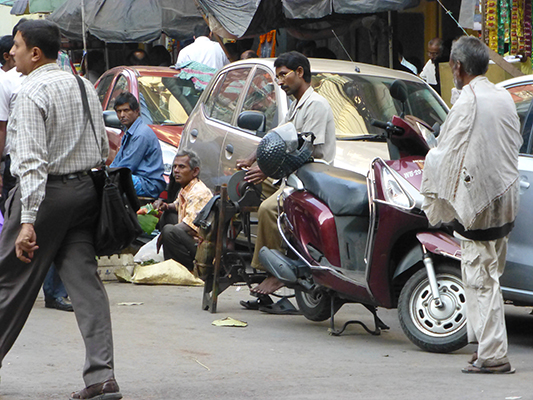
This sort of captures how congested the roads are.

This sort of captures how congested the roads are.

An easier way to navigate the city was to take the train. The train line runs past most of the areas we wanted to see during our visit so we took it often. A train ride usually cost us around 4 rs ($0.08) per person per ride. Not bad. As can be imagined, the train got pretty packed at times. On especially crowded rides we had to join the other riders in jamming ourselves into the already packed train cars. The crowd becomes a huge moving mass of people.
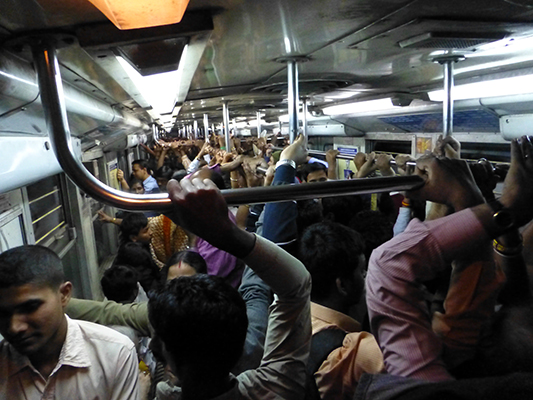
Kolkata city train

Kolkata city train

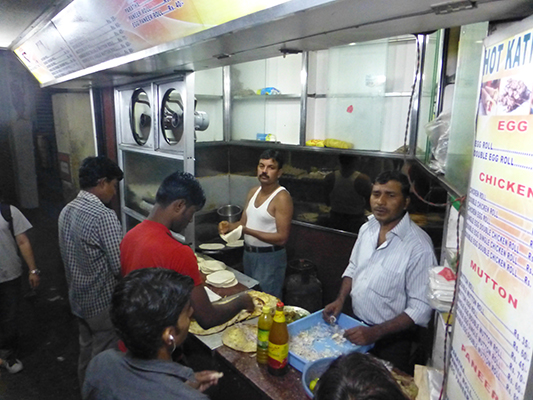
The first night out we discovered Kathi rolls. Think buttered burrito tortilla filled with Indian food. They became a staple food for us because of their low price, around 15 – 45 rs ($0.30 – $0.85) per roll. One roll was sufficient for a meal. The fillings that we tried were paneer (cheese with the consistency of tofu), chicken, vegetables, egg, and combinations of any of those, all with Indian spices. They were a little on the greasy side but very delicious.

Our first Kathi rolls. One chicken and one paneer, both with veggies and spices.
Our first Kathi rolls. One chicken and one paneer, both with veggies and spices.

The master Kathi chefs. The youngest guy on the left rolled the dough into flat circles Then the guy in the back fried the dough and also cooked the fillings on the huge concave frying pan. Next the guy in red filled the fried wraps. The fella in the foreground took orders  and money, and then passed out the goods. Very efficient operation.

The master Kathi chefs. The youngest guy on the left rolled the dough into flat circles Then the guy in the back fried the dough and also cooked the fillings on the huge concave frying pan. Next the guy in red filled the fried wraps. The fella in the foreground took orders and money, and then passed out the goods. Very efficient operation.

Not surprisingly, one of the reasons we were excited to visit India was because of the food. There was plenty to try in Kolkata.
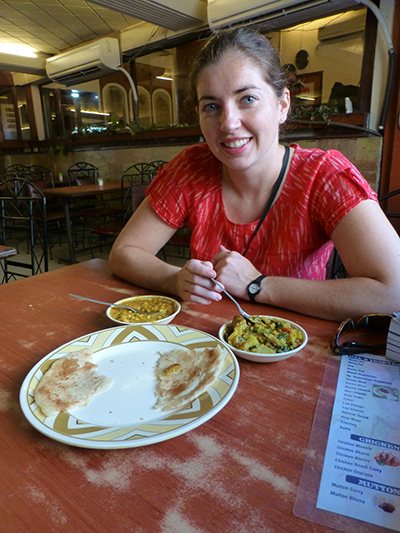
Breakfast a Radhuni. Lentils and vegetable curry with Chapati bread.

Breakfast a Radhuni. Lentils and vegetable curry with Chapati bread.
Breakfast a Radhuni. Lentils and vegetable curry with Chapati bread.

Breakfast a Radhuni. Lentils and vegetable curry with Chapati bread.

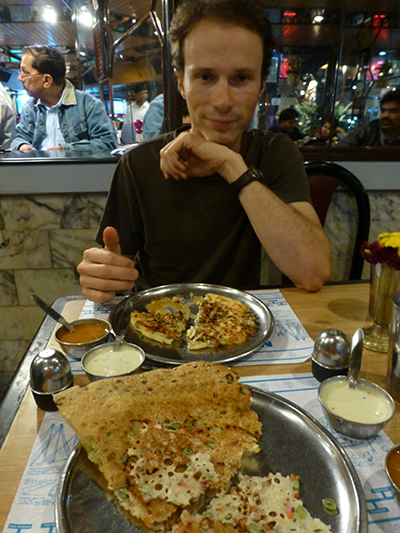
Vegetable dosa (pancake with veggies)

Vegetable dosa (pancake with veggies)

Momos from a food cart.

Momos from a food cart.

Paying the bill at the momo cart. Five momos and a small bowl of soup cost 15 rupees ($0.30).

Paying the bill at the momo cart. Five momos and a small bowl of soup cost 15 rupees ($0.30).

We didn't try any of this fruit, but the sidewalks were filled with guys like this selling all kinds of Indian foods.
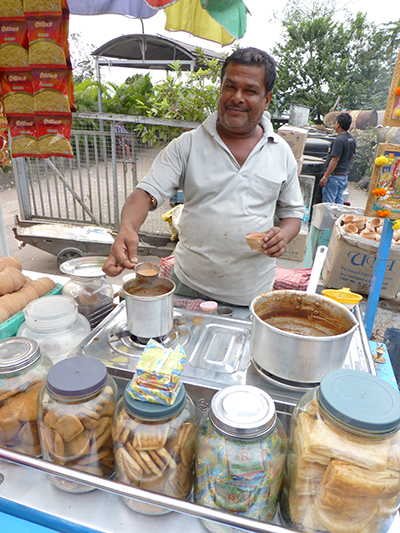
We didn’t try any of this fruit, but the sidewalks were filled with guys like this selling all kinds of Indian foods.

Chai stands were ubiquitous.

Chai stands were ubiquitous.

Some of the chai stands used disposable clay cups instead of plastic. This is good because there was lots of plastic litter everywhere. Some food carts also used bowls made of dry leaves.

Some of the chai stands used disposable clay cups instead of plastic. This is good because there was lots of plastic litter everywhere. Some food carts also used bowls made of dry leaves.

Close up of the clay cup filled with chai.
Close up of the clay cup filled with chai.

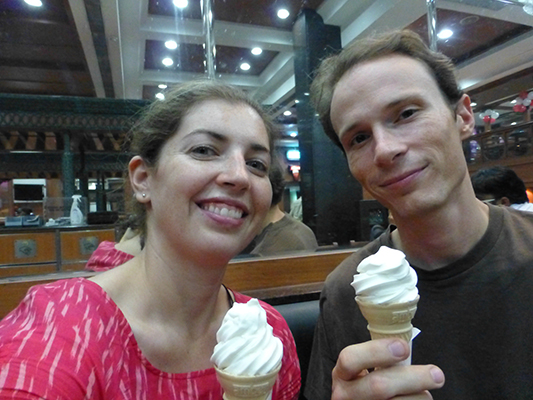
And of course we found McDonald's soft serve ice cream.

And of course we found McDonald’s soft serve ice cream.

Kolkata was the British era capital and is full of architecture and some monuments from that era. One of the most impressive monuments is the Victoria Monument, built in honor of Queen Victoria.
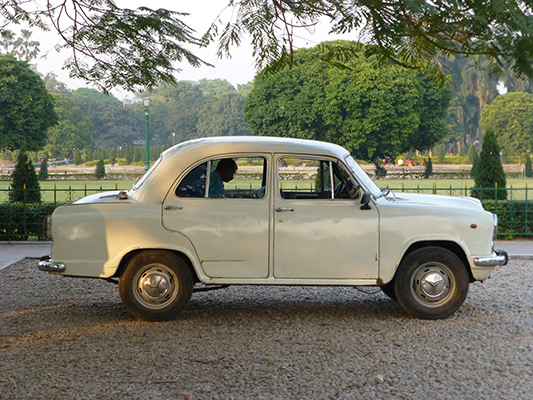
Police car parked outside of the monument. Kolkata was full of this exact car, used as taxis, private cars and police cars.

Police car parked outside of the monument. Kolkata was full of this exact car, used as taxis, private cars and police cars.

Back of Victoria Monument.
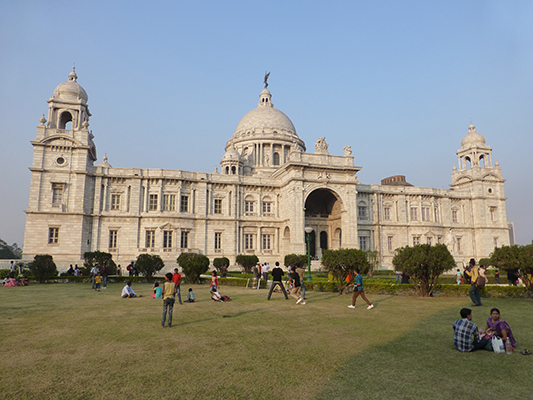
Back of Victoria Monument.

Back of Victoria Monument.

Families use the grounds around the monument as a picnic area and to the escape the hectic city.

Statue of Edward the VII.
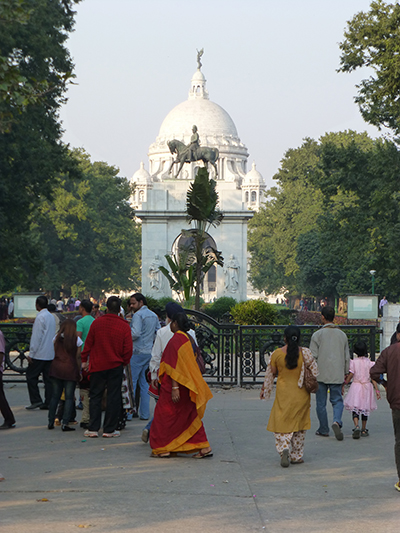
Statue of Edward the VII.

Entrance to Victoria Monument.

Entrance to Victoria Monument.

The crowd of people entering and exiting the monument. There were so many people that a tour of the monument meant walking in a fast moving crowd/line through the monument from start to finish.

The crowd of people entering and exiting the monument. There were so many people that a tour of the monument meant walking in a fast moving crowd/line through the monument from start to finish.

While trying to buy train tickets to our next destination we walked through what used to be the business district of British era Kolkata. The buildings have held up pretty well and seem to be heavily used to this day.

P1060733 P1060734

This guy is sharpening knives on a peddle powered sharpening wheel.

This guy is sharpening knives on a peddle powered sharpening wheel.

P1060930 P1060934

Trolley system still running in parts of the city.

Trolley system still running in parts of the city.

Central A/C.

Central A/C.

Would you buy insurance from these guys?
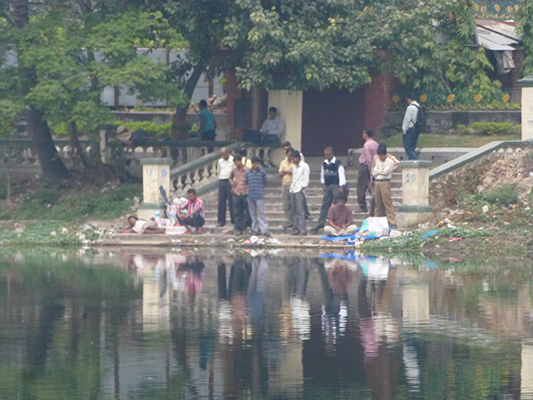
Would you buy insurance from these guys?

Small lake in the old business district.

Small lake in the old business district.

You figure it out.

You figure it out.

The Indian Museum was founded in 1814 and is a huge old building housing some amazing artifacts, ranging from fossils to ancient Hindu stone carvings. We spent the better part of a day exploring the museum and waiting for some of the exhibits to open. Aside from the artifacts, the building and old display cabinets were reason enough to visit the museum. It felt like we’d traveled back in time.

A couple hours after opening the museum really started to fill up.

A couple hours after opening the museum really started to fill up.

175th Anniversary plaque.

175th Anniversary plaque.

Queen Victoria statue.

Queen Victoria statue.

Museum hallway.
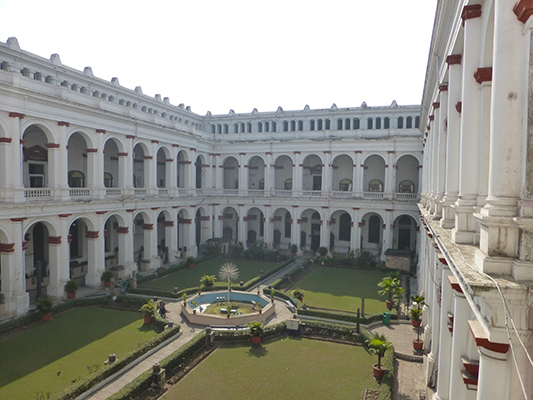
Museum hallway.

Museum courtyard.

Museum courtyard.

Giant deer.

Giant deer.

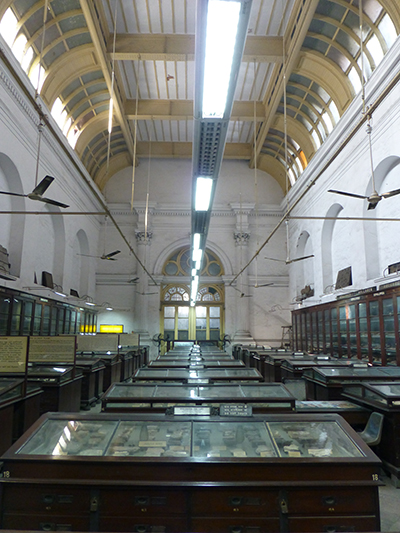
One of the exhibit halls.

One of the exhibit halls.

Beautiful old display cabinets.

Beautiful old display cabinets.

It looked like many of the exhibits had been locked up for decades. Many artifacts were covered in a thick layer of dust.

It looked like many of the exhibits had been locked up for decades. Many artifacts were covered in a thick layer of dust.

Some of the exhibits were unfortunately closed.

Some of the exhibits were unfortunately closed.

Human fetus.

Human fetus.

Eight legged lamb.

Eight legged lamb.

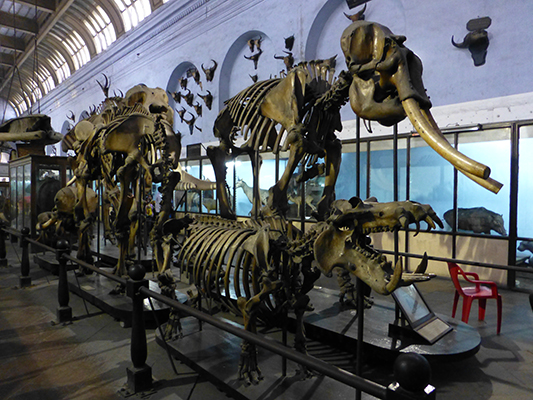
Hippo and Asian Elephant skeletons.

Hippo and Asian Elephant skeletons.

After finding the foreign ticket office and bringing the correct documentation, we bought our tickets and made are way to Darjeeling by train. This was our first experience with the train system in India. According to our guide book, the Indian rail system is the largest employer in the world with roughly 1.5 million workers, and transports around 20 million people everyday. Wow!

Being our first experience with the train in India we didn’t know what to expect. The station in Kolkata is huge and was filled with hundreds, maybe thousands of people. Similar to our experience on the flight to India, the train station was a frenetic place with people running back and forth every few minutes or so as platform numbers were announced. Each platform was full of people, luggage, and tons of cargo. As is common in densely populated areas in India, the smell of urine and feces was in the air. There were dogs everyone, food venders, and men moving cargo bag and forth from platform to platform. While waiting for our train we got to experience many more of the curious stares from Indians we’ve come to accept. Suffice to say, it was an exciting, slightly overwhelming experience.

The train ride itself went off without a hitch and we arrived in Darjeeling the next day. There were a few more surprises though. Many beggars, people giving blessings and asking for merit/payment in return, and what I can only describe as rude gypsies clapping loudly in your face and then expecting some money in return passed through the train several times. This gave us more practice at saying “No” in an even more convincing manner. All in all an interesting experience to say the least.
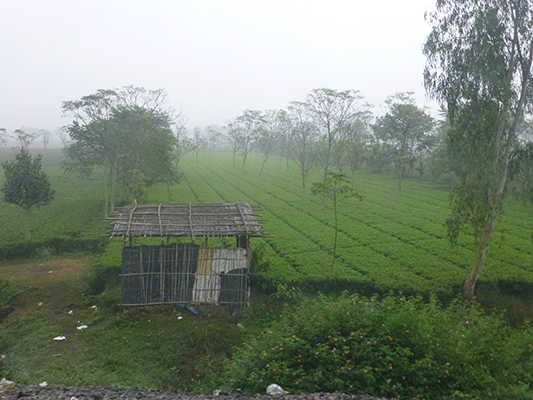
One of the many farms we saw during our ride to Darjeeling.

One of the many farms we saw during our ride to Darjeeling.

There was no need to buy the more expensive A/C train tickets since the temperature was plenty cold.

There was no need to buy the more expensive A/C train tickets since the temperature was plenty cold.

The sleeper car we stayed in. The Foreign ticket office worker reserved us the two bunks on the right, as opposed to the six grouped together on the left, stacked three high.

The sleeper car we stayed in. The Foreign ticket office worker reserved us the two bunks on the right, as opposed to the six grouped together on the left, stacked three high.

The train platform in Kolkata. Of course, people were eager to enter the train to get to their ASSIGNED SEATS!
The train platform in Kolkata. Of course, people were eager to enter the train to get to their ASSIGNED SEATS!

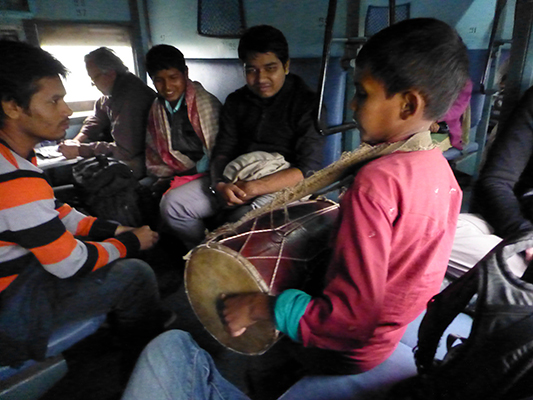
This young guy came through our train car to sing and drum in an effort to earn a little money. It worked.

This young guy came through our train car to sing and drum in an effort to earn a little money. It worked.

Kolkata was a great introduction to India. It gave us a taste of some of the many characteristics of the country. That said, I’m sure there’s much more to experience.
Categories: Architecture, Cities, South East Asia, Traveling | Tags: , , , , , | Leave a comment

Pak Chong, Khoa Yai National Park, and Silk in Surin

After our break in Railay we decided to get back on the travel wagon and head for the great outdoors of Khoa Yai National Park near Pak Chong.

We took a brief research detour to the city of Patong, which is on Phuket Island. The one night stay was enough for us to know we didn’t want to stay there in the future with my family. Patong is VERY touristy, the most we’ve experienced so far. And with that comes the frustration of saying “no, I don’t want a taxi or tuk tuk, no I don’t want a suit, no I would not like a massage” over and over again. We booked it out of there the following day and heading up north and then east to the city of Pak Chong.

Pak Chong is  a smaller city that doesn’t have many tourist come through. It’s always refreshing to stay in a town like this. The people are more curious about you and very willing to help without expecting you to visit their shop or buy something from them. Dave and I have come to realize we enjoy towns like this much more than any touristy town out there. The lonely planet guides usually do a really good job of creating touristy towns, so these small gems are a lot harder to find.

We were both exhausted from the 13-14 hour overnight bus to Bangkok and the 3 hour bus from Bangkok to Pak Chong, so we decided to stay in the closest hotel we could find. The hotel was called Pak Chong Hotel and was right across the street from the night market. We indulged ourselves in the best Pad Thai we’ve had so far in Thailand, these crepe type things, waffles, and Happy Milk shakes. All of these were a total of 160 Baht ($5.20), which is what Dave and I spent on dinner or lunch in Railay. These night markets or even the day markets are perfect for us and our budget.

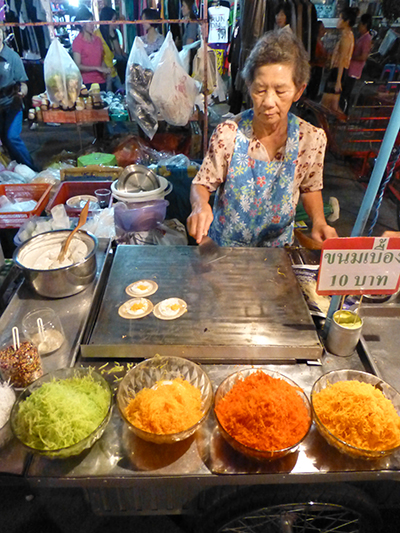
Making the crepe things.

Making the crepe things.

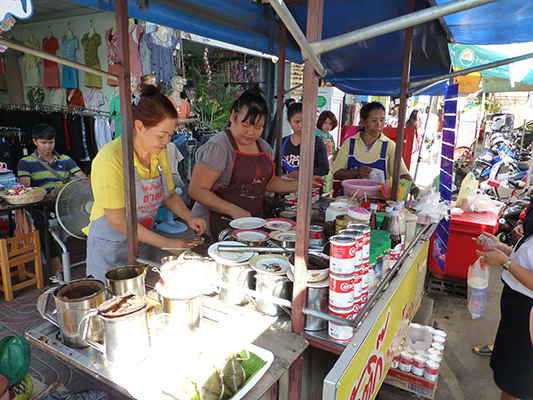
The food station where we got our pad thai.

The food station where we got our pad thai.

Best pad thai so far

Best pad thai so far

Night markets are cheap and offer lots of yummy food.

Night markets are cheap and offer lots of yummy food.

Waffles. We tried the coconut, chocolate, and corn one. They all tasted like butter to us.

Waffles. We tried the coconut, chocolate, and corn one. They all tasted like butter to us.

Happy Milk milk shakes.

Happy Milk milk shakes.

The "American" breakfast that was included with the hotel. Some how they think Americans eat hot dogs and various other forms of pork for breakfast. Not sure where this came from.

The “American” breakfast that was included with the hotel. Some how they think Americans eat hot dogs and various other forms of pork for breakfast. Not sure where this came from.

The following day we decided to book a tour of the national park with one of the companies that offered it. We decided to go with Bobby’s Apartments and Jungle Tours rather than Greenleaf, which was the only other option, for multiple reasons.

  • The cost of the tours was the same 1500 baht/person, BUT, the rooms were only 200 baht per night vs. 300 baht for Greenleaf
  • They included free Wi-Fi – not sure if Greenleaf does, it’s not on their website
  • Hot water showers
  • They both have 5 stars for reviews
  • And to top it all off, we had called Greenleaf the day before when we were undecided about doing a tour or not and they told us “no tour, then you can’t stay here, bye” which we didn’t appreciate at all

The tour was split into two days. The first included a swim in a natural spring, a tour of a cave where a bunch of bats live, a yummy fruit and cracker snack, and then watching millions of bats leave the cave at dusk. When I say millions, I am not exaggerating. It was amazing. They started to come out around 6:15pm and were still coming out when we left around 6:35pm. We were told it takes about an hour for all of the bats to leave the cave. It was an awesome experience that I know pictures won’t be able to capture.

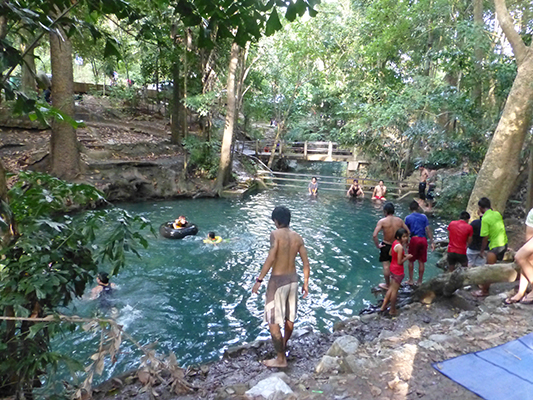
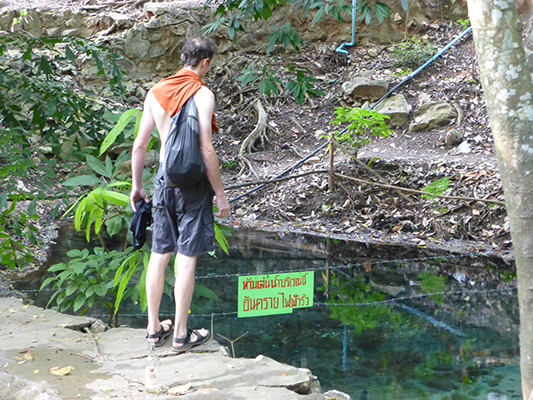
The water was a little cold, very refreshing. A lot of the locals went in with all their clothes on.

The water was a little cold, very refreshing. A lot of the locals went in with all their clothes on.

Dave checking out the source of the spring

Dave checking out the source of the spring

Another section of the river

Another section of the river

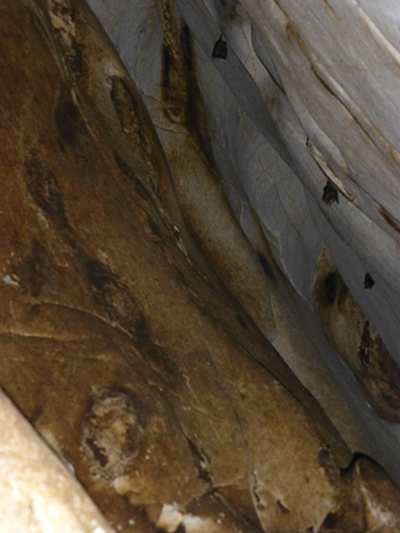
Bats sleeping in their cave.

Bats sleeping in their cave.

Sun setting at the farm where the bat cave entrance was.

Sun setting at the farm where the bat cave entrance was.

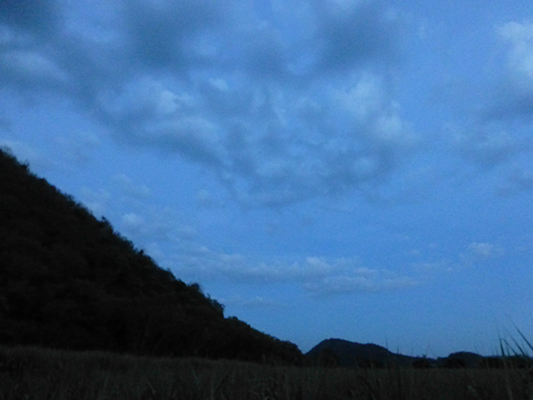
It's a little hard to see them, but you can see a zig-zag trail of bats coming from the mountain.

It’s a little hard to see them, but you can see a zig-zag trail of bats coming from the mountain.

Another picture trying to capture the bats.

Another picture trying to capture the bats.

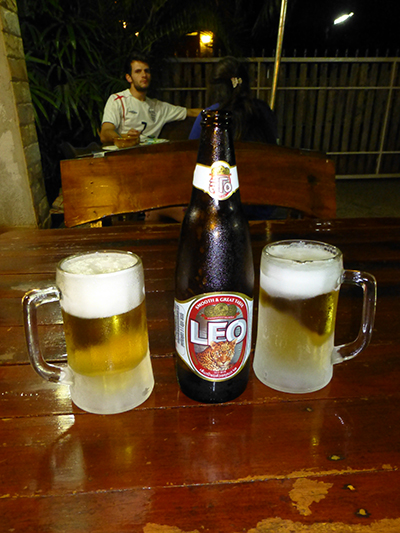
Enjoying a local beer after our first day.

Enjoying a local beer after our first day.

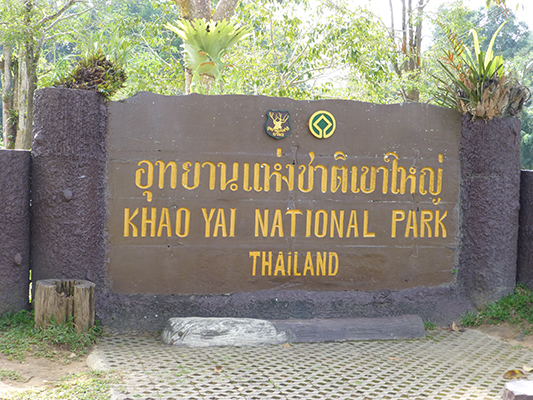
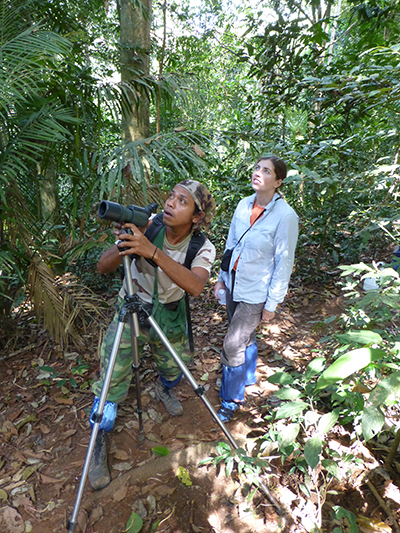
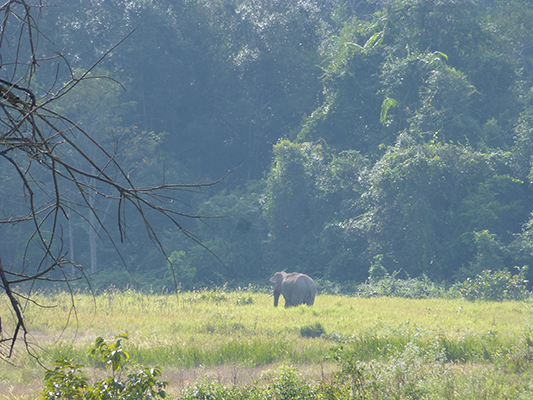
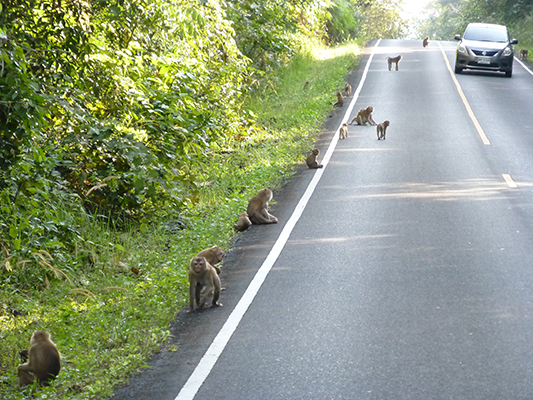
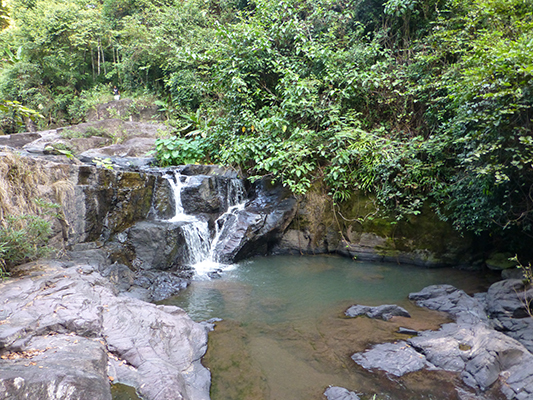
The second day was our trip into the Khoa Yai National Park and consisted of a visit to the visitors center, a hike through the jungle to look for animals and have lunch, a short walk to the biggest waterfall in the park, a swim in a smaller waterfall, and a never ending search for monkeys, birds, and elephants. Guess what? We got lucky and got to see all three plus a very poisonous viper and the pincers of a scorpion. Our guide did a very good job finding the animals and sharing the experience with us. I would recommend Bobby’s Jungle tours alone for the guide we had, of course, I didn’t experience other tour guides they might be just as good or better. I’ll never know.

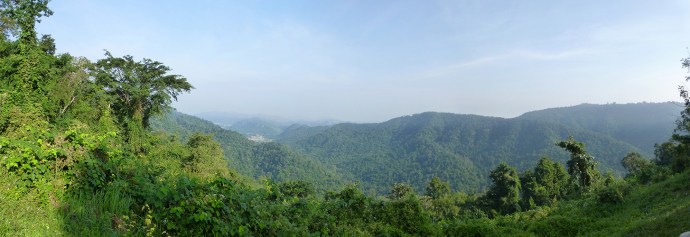
Panoramic from the view point in the park. Reminded us of the smokey mountains.

Panoramic from the view point in the park. Reminded us of the smokey mountains.

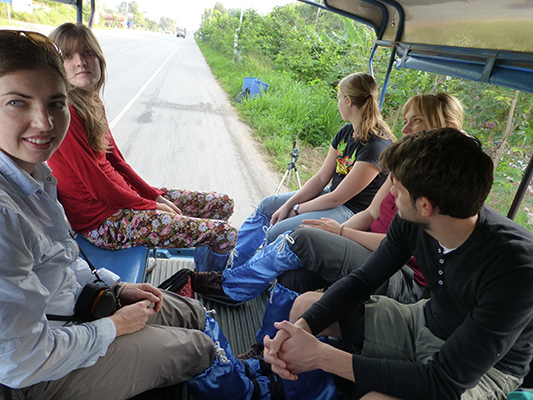
The pick-up truck ride that drive us around for the day and our fellow tourist.

The pick-up truck  that drove us around for the day and our fellow tourist.

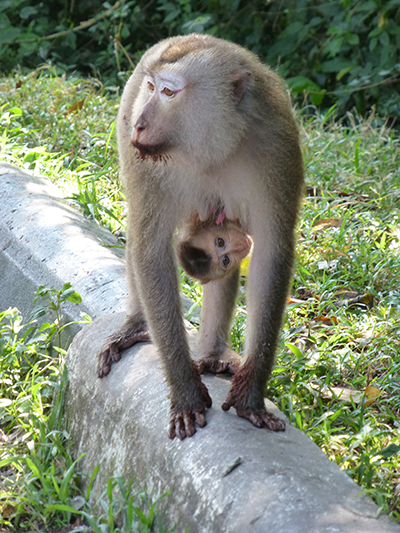
Monkeys and their babies.

Monkeys and their babies.

P1060348

Headed into the jungle to look for gibbons.

Headed into the jungle to look for gibbons.

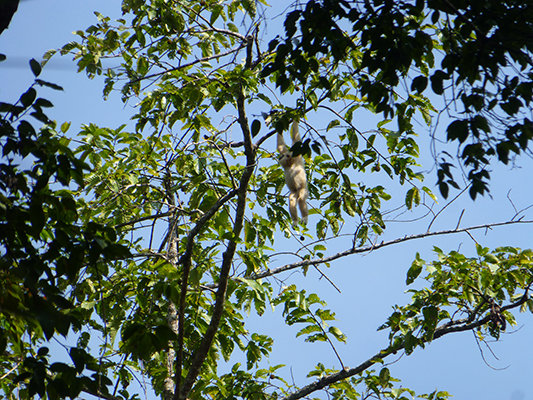
Found some. Apparently these guys are very shy and you don't see them much. We got lucky.

Found some. Apparently these guys are very shy and you don’t see them much. We got lucky.

They have a really cute face and are pretty fuzzy.

They have a really cute face and are pretty fuzzy.

Hanging monkey.

Hanging monkey.

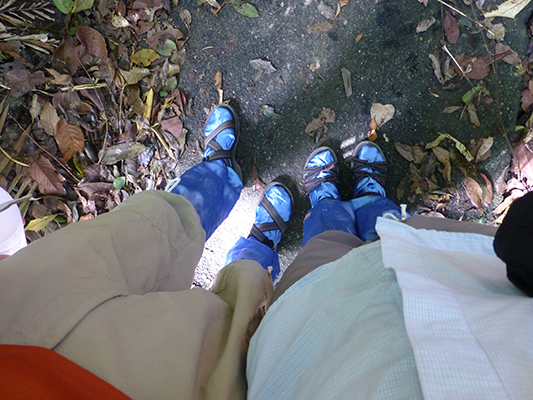
Our blue leech socks.

Our blue leech socks.

Sun bathing turtle

Sun bathing turtle

Barking deer

Barking deer

We also got to try some Holland candy. Which tasted like licorice and salt. They like them, I do not.

We also got to try some Holland candy. Which tasted like licorice and salt. They like them, I do not.

Scorpion do not like to be woken up during the day with a stick.

Scorpion do not like to be woken up during the day with a stick.

Still trying to get the scorpion to come out.

Still trying to get the scorpion to come out.

Huge termite nests.

Huge termite nests.

Huge trees.

Huge trees.

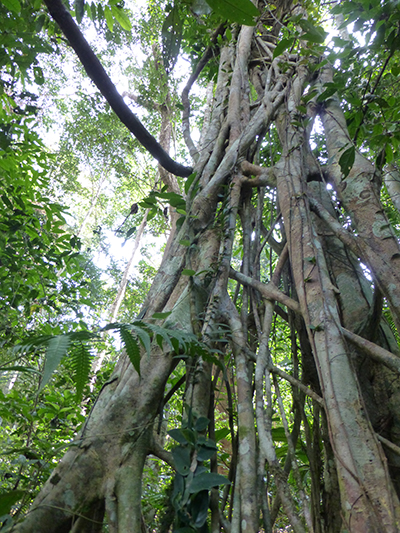
This is a fig tree. They grow on other trees until the other tree eventually dies and then gets eaten by termites.

This is a fig tree. They grow on other trees until the other tree eventually dies and then gets eaten by termites.

Trying to wake up another scorpion. No luck.

Trying to wake up another scorpion. No luck.

Bird watching is hard work. They move very fast.

Bird watching is hard work. They move very fast.

Gross spiders

Gross spiders

Cool trees.

Cool trees.

Lunch was rice with lemon-grass curry. Very tasty.

Lunch was rice with lemon-grass curry. Very tasty.

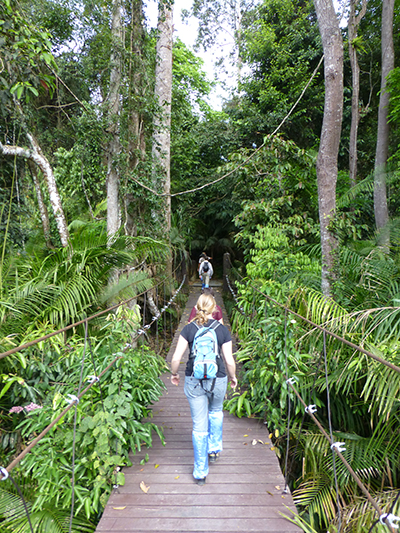
Trekking through the jungle.

Trekking through the jungle.

Large fig tree.

Large fig tree.

Lizard.

Lizard.

Very poisonous viper that was only about two feet away from the trail.

Very poisonous viper that was only about two feet away from the trail.

Wild Elephant!

Wild Elephant!

So many monkeys

So many monkeys

Largest waterfall in the park.

Largest waterfall in the park.

Swimming hole.

Swimming hole.

To finish the day off, a beautiful sunset.

To finish the day off, a beautiful sunset.

The day after the tours we decided to go further east to Surin by train. We were told that the trains were a little unpredictable, but decided it would be easier than buses. Well, the train showed up 2 hours late and took about 45 minutes longer than we thought. But, it didn’t cost much and we were in no real rush, so it worked.

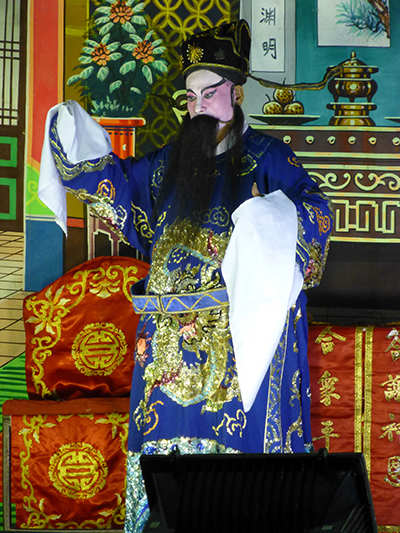
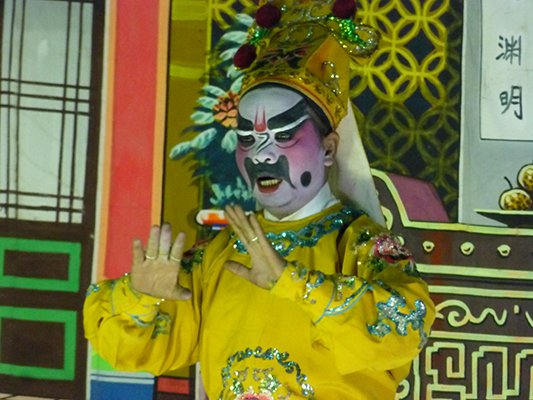
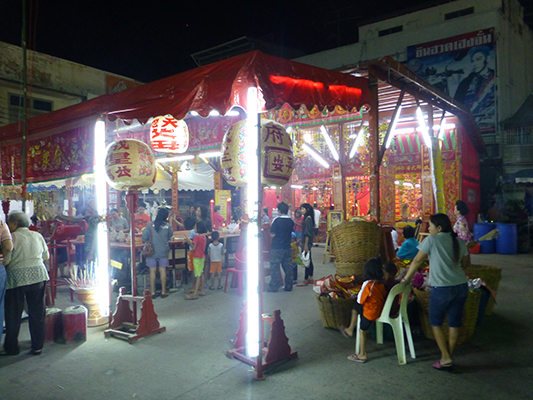
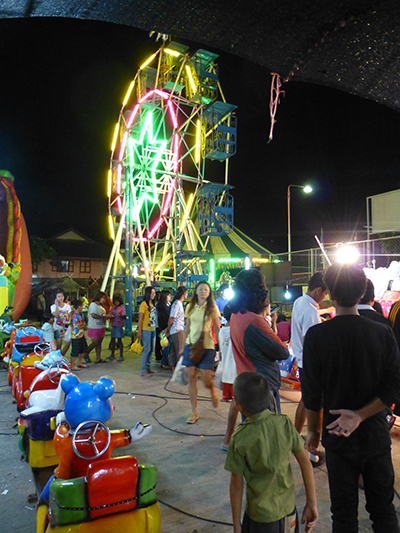
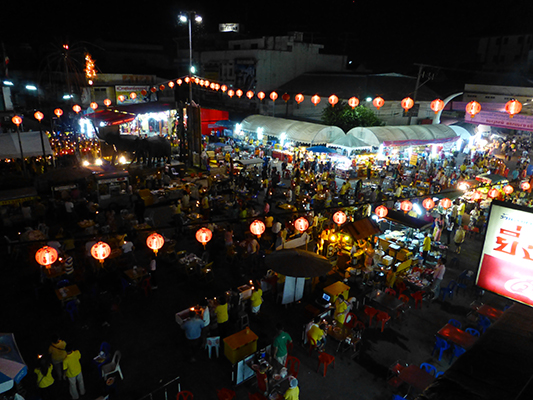
When we got off the train we walked into a festival happening in the square. We were told it was a Chinese Opera, but to us it seemed like a lot of singing, dancing, and carnival like games. We didn’t find the Chinese opera until the last night and it was very hard to hear and understand them. We think this was all for the king as it was the King of Thailand’s birthday the day after we arrived. The festival lasted the whole time we were there, which was very lucky for us as Surin is a small sleepy sort of town. But we did enjoy all of the food that came along with this festival. We did get Pad Thai again, but we tried some different things that looked like egg rolls and these cake type things with different toppings. We also got to see the whole town stop what they were doing and sing happy birthday to the king, or maybe it was the national anthem, either way, it was a cool experience. But this was only an added bonus for coming to Surin, we didn’t actually know that was happening until we got there.

Also, all the actors looked very distracted and annoyed that they had to perform at all.

Also, all the actors looked very distracted and annoyed that they had to perform at all.

Again, they were speaking and singing in Chinese, so even the Thai people didn't know what they were saying.

Again, they were speaking and singing in Chinese, so even the Thai people didn’t know what they were saying.

One of the characters in the opera

One of the characters in the opera

This was part of the Chinese Opera. They gave you burning incense to pray in a distinct order throughout this tent. We were someone lost and Dave burned himself numerous times. It was interesting though.

This was part of the Chinese Opera. They gave you burning incense to pray in a distinct order throughout this tent. We were someone lost and Dave burned himself numerous times. It was interesting though.

Traditional Thai dancing by 6 year olds.

Traditional Thai dancing by 6 year olds.

Rides and carnival games for the kids.

Rides and carnival games for the kids.

The cake dessert with different toppings. One was port, we didn't get that one.

The cake dessert with different toppings. One was pork, we didn’t get that one.

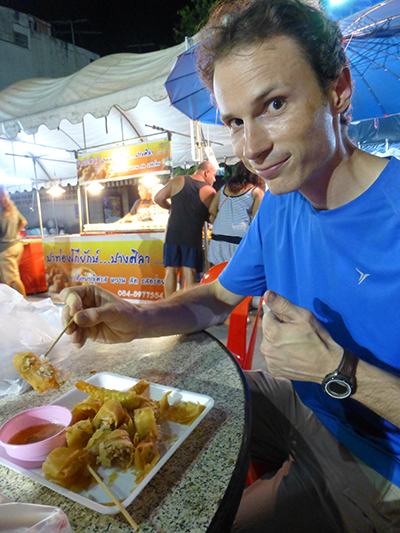
Dave trying the egg rolls.

Dave trying the egg rolls.

I think this is jelly fish. We didn't try it.

I think this is jelly fish. We didn’t try it.

Roasted chestnuts.

Roasted chestnuts.

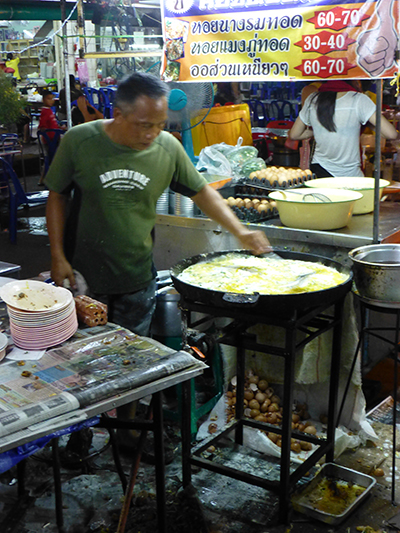
This guy made some sort of egg dish all night on this giant frying pan.

This guy made some sort of egg dish all night on this giant frying pan.

The king projected on the big screen

The king projected on the big screen

Everyone stopped and singing what we think was happy birthday to the king.

Everyone stopped and singing what we think was happy birthday to the king.

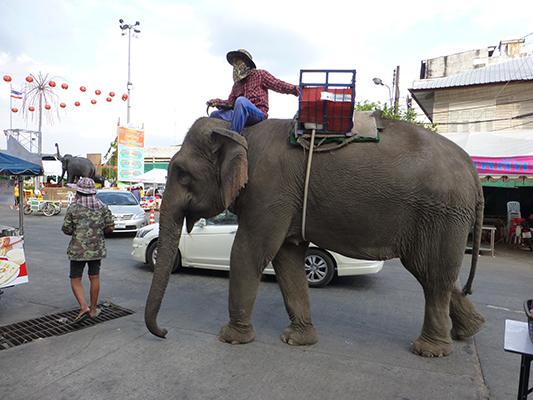
Surin was more famously known for it's Elephant round up. Which has thousands of elephants playing games and such. It was in November so we missed it by a week or so. But we still saw elephants in the town.

Surin was more famously known for it’s Elephant round up. Which has thousands of elephants playing games and such. It was in November so we missed it by a week or so. But we still saw elephants in the town.

The reason we did come to Surin is the nearby silk villages. The experience to and from was more exciting than we had expected. Our hotel recommended we take a tuk tuk to and from the village as it would be easier. It was also going to cost an estimated 300 baht ($10), most likely both ways. In our book it says you can take a local truck for 15 baht or 30 baht ($1) total for both of us, a tenth of the cost. Being budget travelers we went with the cheaper option, we’ve taken local trucks before anyway, no biggie. We set off with only the name of the truck we were suppose to take and the town it was going to. We stopped in a local store where the 3 people working deciphered what we wanted from our poor rendition of the Thai words for truck and the town name. Eventually they pointed us in the correct direction, which was the market down the street. We managed to find the market from the direction they gave us, but there was 10-20 trucks all with Thai writing parked around the market. Again, we asked some locals using the same Thai words as before. This time they laughed after we mentioned the town, Ban Tha Sawang, and pointed us towards a street that held most of the trucks. Still not knowing which truck to take, we proceeded to ask every truck “Ban Tha Sawang?” and were pointed in the general direction of the trucks behind them with a laugh afterwards. Finally we found it, but people from other trucks were still yelling out “Ban Tha Sawang” and then laughing afterwards. We were amused by the whole experience and still not fully sure we were on the correct truck. I don’t think many non-locals opt to take these trucks.

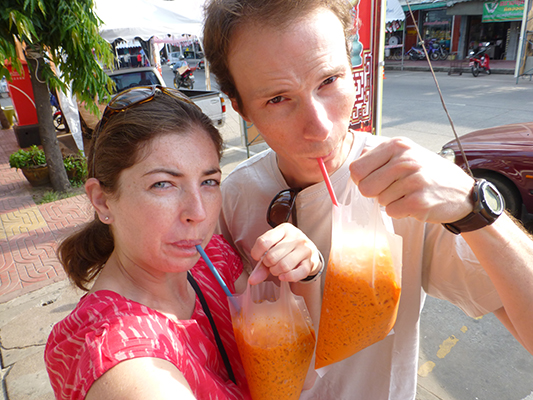
Thai iced tea stand.

Thai iced tea stand.

Iced tea in a bag!

Iced tea in a bag!

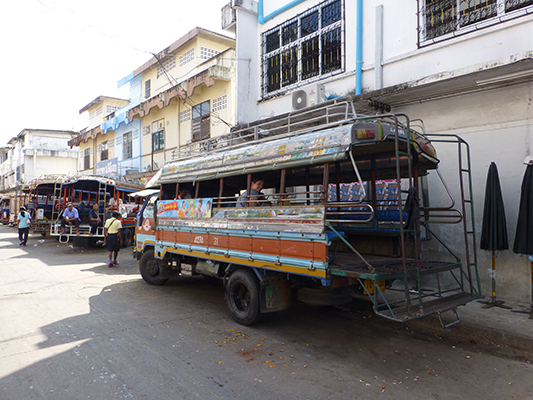
The truck we took to the silk village.

The truck we took to the silk village.

We arrived!

We arrived!

Anyway, we were on the correct truck and made it to the village. We checked out how they make the silk and shopped around for a couple of hours. Finally decided on a silk handmade scarf for me and a silk scarf that we’re going to use as a table runner whenever we get a table back home.

Silk weaving location

Silk weaving location

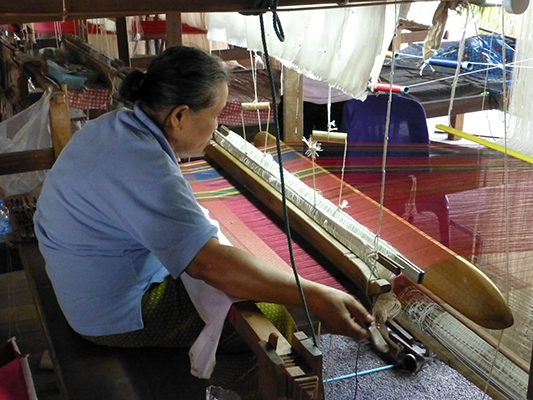
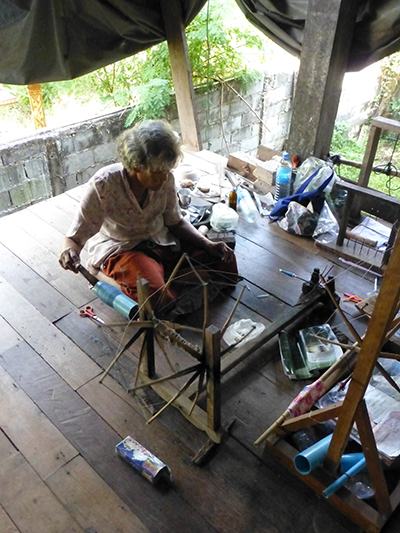
A couple of the women weaving. We are still not sure what everything is for, we did not get an explanation.

A couple of the women weaving. We are still not sure what everything is for, we did not get an explanation.

We did see this women take this wooden stick and throw it back and forth. The stick had gold silk attached to the end of it.

We did see this women take this wooden stick and throw it back and forth. The stick had gold silk attached to the end of it.

One of the weavers putting silk onto a bobbin.

One of the weavers spooling the silk.

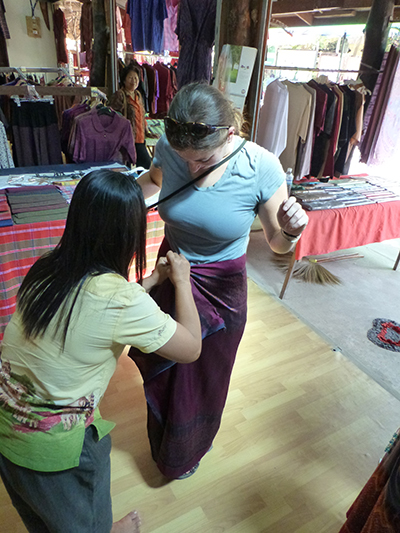
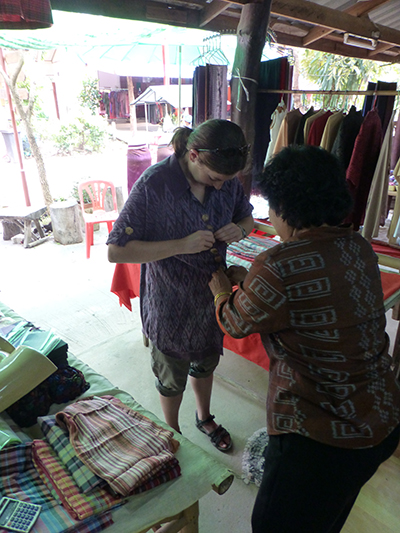
I tried on one of the silk skirts and asked them to tie it how they normally would have.

I tried on one of the silk skirts and asked them to tie it how they normally would have.

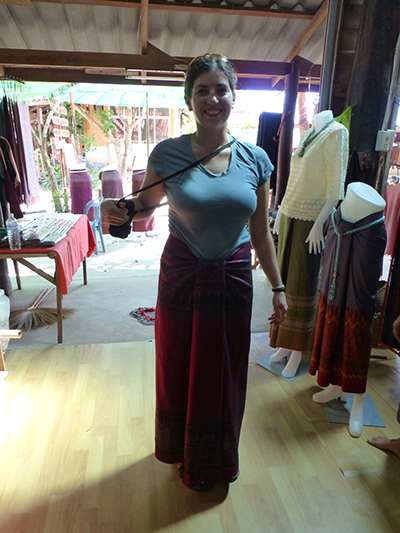
Pretty cool. But I would never wear this.

Pretty cool. But I would never wear this.

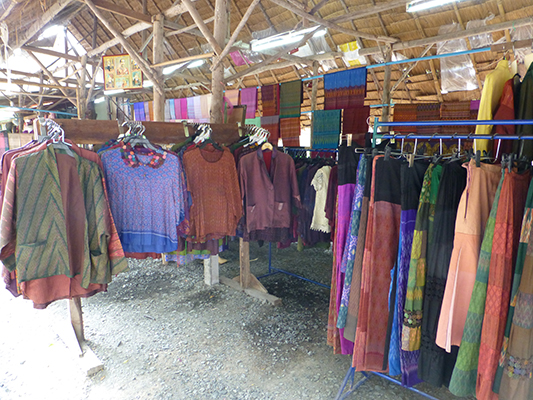
One of the many shops.

One of the many shops.

Trying on a one-size fits all dress. Not flattering on me at all.

Trying on a one-size fits all dress. Not flattering on me at all.

After this, we went to the location we were dropped off at and waited for a return truck. Thirty-five minutes into the wait a nice, older gentleman on a scooter asked us if we were waiting for a truck back to Surin. We said yes and he proceeded to tell us that sometimes they come and sometimes they don’t, so he was going to try and tell someone that we were waiting. We said thanks, both slightly confused as to what he meant. He went over to the side of the road and started to wave his hand, the equivalent of holding up your thumb, to hitchhike a ride back to Surin for us. Both of us kind of chuckled and wondered if this was 1. allowed and 2. normal practice. There was no stopping him, so we went along with it. Well, no luck and he said he was very busy. So we thanked him and waited another 10 minutes when we decided that after a total hour of waiting we would walk the 8km (5 miles) back if there was no ride. Another 10 minutes went by, 5 minutes before we decide to hoof it, Dave gets up the courage to start to wave at people. We had decided we would have better luck with pick-up trucks and we got lucky, there were three in a row and one of them actually stopped! Lucky us! Two nice young ladies in a pickup brought us back to town and wouldn’t even allow us to pay them. All in all, I’m glad we didn’t opt for the tuk-tuk, because the experience to and from the silk village ended up being better than the silk village itself.

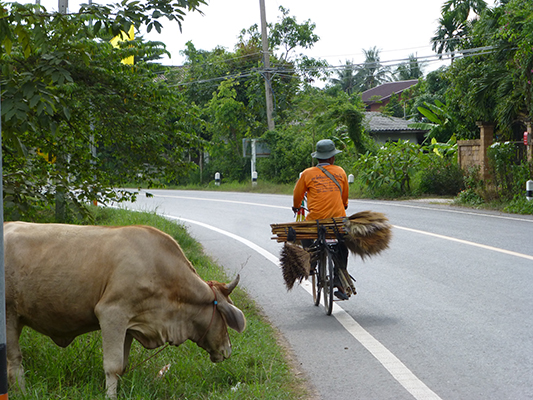
This is just to show how rural the place was.

This is just to show how rural the place was.

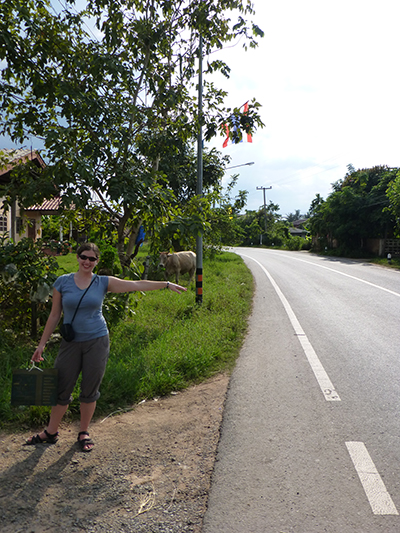
Hitchhiking. Dave actually did this for our ride.

Hitchhiking. Dave actually did this for our ride.

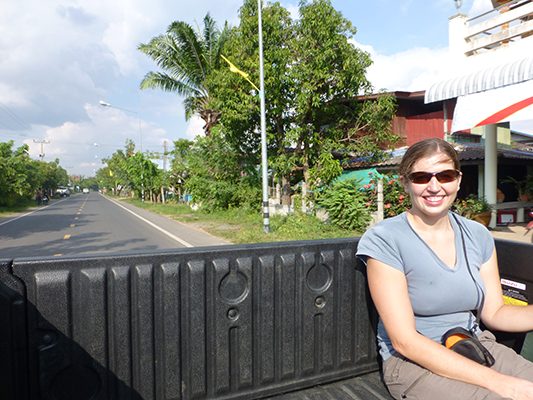
Wahoo, we don't have to walk back.

Wahoo, we don’t have to walk back.

We didn't get a picture with the ladies, but we snapped a shot of the truck.

We didn’t get a picture with the ladies, but we snapped a shot of the truck.

Categories: Cities, Handicrafts, Nature, Outdoors, South East Asia, Traveling | Tags: , , , , , , , , | Leave a comment

Railay, Thailand

There are many things about Thailand that attract tourists. One of its biggest draws are its beaches. Neither Sarah nor I are big fans of beaches. They usually involve a lot of sitting around baking in the hot sun, with an occasional dip in the ocean. But Thailand’s beaches, specifically those near the town of Krabi on the west coast along the Andaman Sea, have a lot more to offer than, say, the beaches of Florida.

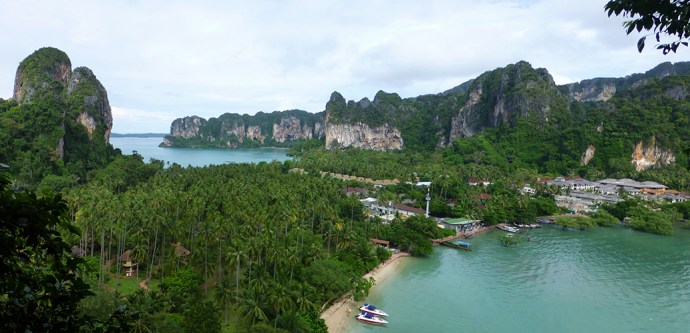
A shot of West and East Railay from above.

A shot of West and East Railay from above.

This section of Thailand is full of huge limestone cliffs that aren’t found elsewhere in Thailand. These limestone cliffs add a flavor that most other beaches don’t have, and it’s that extra flavor that drew us to the small coastal town of Railay. Though small, Railay packs a good variety of activities, including climbing, kayaking (near the beautiful cliffs), spelunking, snorkeling, short hikes, and of course, lounging on the beach. Also, Railay can only be reached by boat, which adds to its allure.

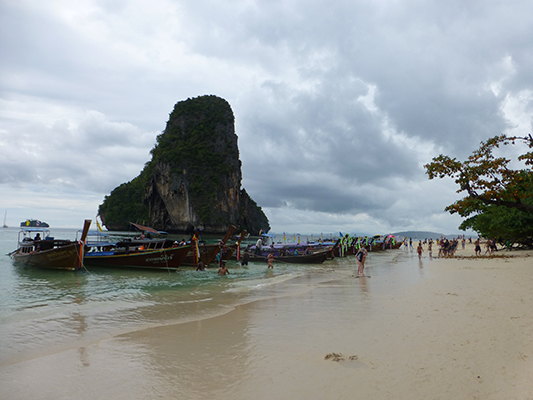
This is the main mode of transport to Railay. It's a long tail boat. The name is derived from the long propeller shaft coming off the back of the boat.

This is the main mode of transport to Railay. It’s a long tail boat. The name is derived from the long propeller shaft coming off the back of the boat.

A closer shot of the long tail boat's propulsion system. It's a little scary if you're close to the boats when they lift this thing out of the water.

A closer shot of the long tail boat’s propulsion system. It’s a little scary if you’re close to the boats when they lift this thing out of the water.

The workers on the island are ferried from the boats to land using a rolling platform pulled by a tractor. We had to walk through the water.

The workers on the island are ferried from the boats to land using a rolling platform pulled by a tractor. We had to walk through the water.

Long tails lining the beaching waiting to transport riders.

Long tails lining the beaching waiting to transport riders.

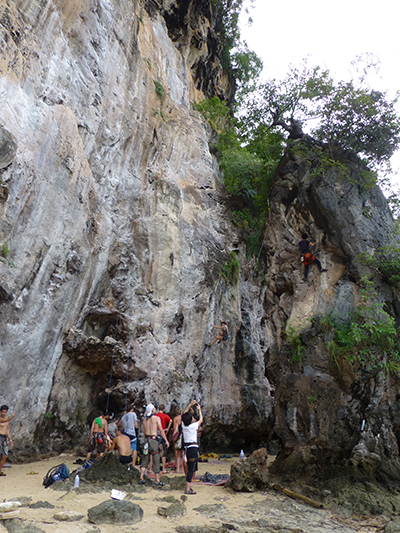
We went there with the intention of doing a little bit of relaxing on the beach, especially after our Myanmar travels, and climbing. We ended up doing nearly everything but climbing. We’re both climbers and were psyched to climb but, we procrastinated long enough that heavy rains showed up by the time we were ready to commit to renting gear. So, sadly, we didn’t climb. But we’re way out of climbing shape anyway, so there wouldn’t have been much climbing happening. Here are some photos of the climbing we didn’t do.

This set of climbs is right on the best beach in Railay

This set of climbs is right on the best beach in Railay

More popular beginner climbs.

More popular beginner climbs.

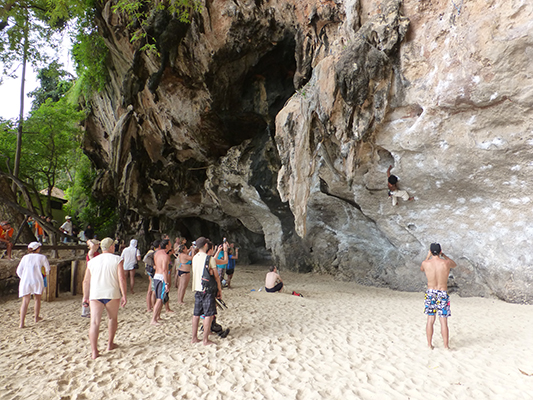
One of the more popular areas for guided climbing.

One of the more popular areas for guided climbing.

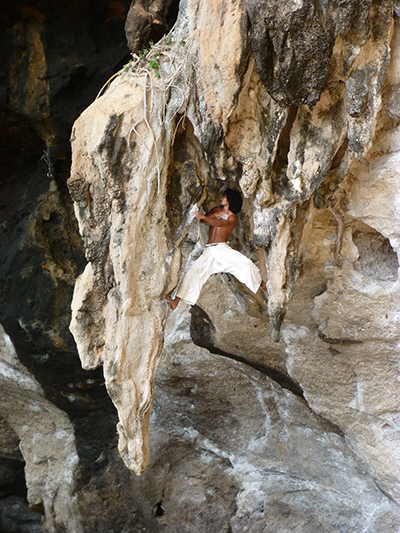
It was common to see beach goers watching climbers. This guy seemed to be a local and was very much performing for the crowd.

It was common to see beach goers watching climbers. This guy seemed to be a local and was very much performing for the crowd.

More of the climbing performance.

More of the climbing performance.

Because of the beautiful scenery, Railay is definitely some of the best beach bumming I’ve ever done. And with the cliff overhangs you could even swim while it was raining. Bonus!

This was one of the coolest areas to swim, solely because of the crazy stalactites hanging overhead.

This was one of the coolest areas to swim, solely because of the crazy stalactites hanging overhead.

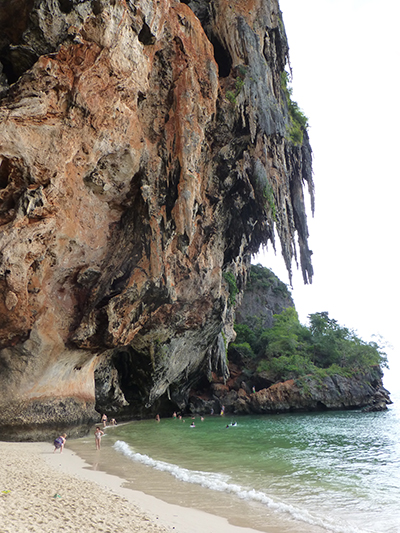
Good size beach backed by huge cliffs. Awesome!

Good size beach backed by huge cliffs. Awesome!

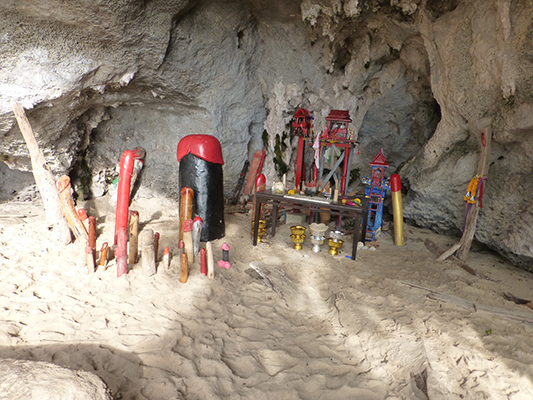
Probably the oddest thing we saw in Railay were the two caves filled with phallic wood carvings. Didn’t really get the story on this but I think it’s some sort of offering local fisherman make to the goddess Phra Nang.

Penis cave 1

Penis cave 1

Penis cave 2. It's not a contest but I think cave 2 has the biggest collection.

Penis cave 2. It’s not a contest but I think cave 2 has the biggest collection.

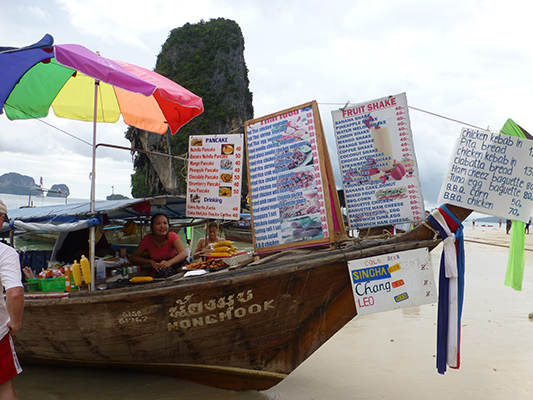
The long tail boats also act as portable restaurants, or food trucks of the ocean. Beach area is obviously pretty expensive. So to avoid paying the cost of opening a restaurant on the beach, several boat owners converted their boats to kitchens that they pulled up to the shore each day to sell food.

Pad Thai from the boat kitchen. Cost about 60 Baht ($2). That's about double of what it costs from a food cart in a bigger city. Everything in Railay was more expensive though.

Pad Thai from the boat kitchen. Cost about 60 Baht ($2). That’s about double of what it costs from a food cart in a bigger city. Everything in Railay was more expensive though.

The daily menu. Pretty large for such a small kitchen.

The daily menu. Pretty large for such a small kitchen.

Satisfied customer.

Satisfied customer.

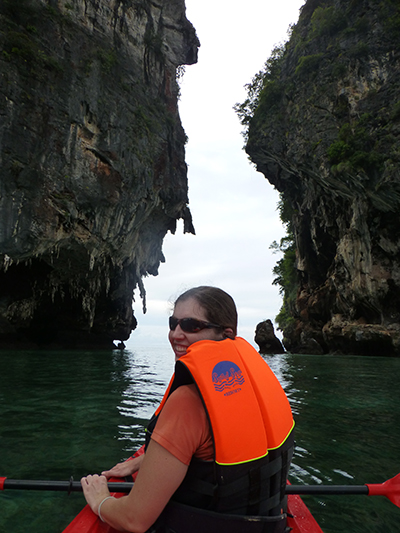
There were even more cliffs further out, completely detached from the mainland. We rented kayaks for a couple hours one day to explore some of them. While checking them out we discovered that surrounding them was crystal clear, shallow water, great for snorkeling. So we decided to do a bit of snorkeling a couple days later.

Unfortunately, we didn’t bring our own snorkeling equipment but were lucky enough to have some lent to us for free by one of the hotels. They felt sorry for us because there wasn’t any for rent anywhere else. Hotels typically provide it for their guests. Our hotel didn’t. This would be a good time to mention how awesome Thai people have been to us during our time in Thailand. They are some of the nicest folks we’ve come across, anywhere. There have been several occasions where someone has spoken up for us or offered help when it was obvious we needed it.

Long tail boat hanging out near one of the small island cliffs.

Long tail boat hanging out near one of the small island cliffs.

Sarah leading the way on the kayak.

Sarah leading the way on the kayak.

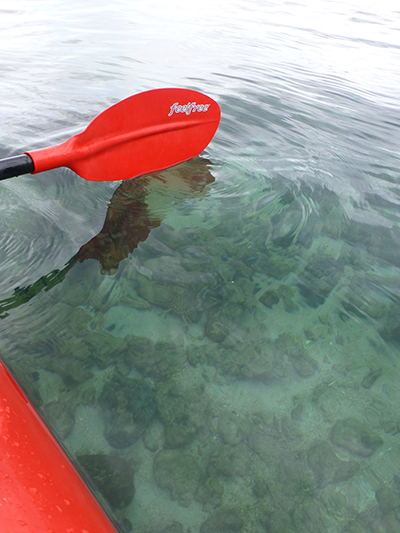
It's so clear.

It’s so clear.

We kept wondering just how often those stalactites break loose.

We kept wondering just how often those stalactites break loose.

Being a remote tourist destination, Railay was a little more expensive than some of the other areas we visited in Thailand. The west side of the Railay especially so. That said, we were able to find an affordable bungalow to rent and a couple restaurants that served good, cheap food. Our bungalow only had a fan but, that’s all you really need at night. It cost us 400 Baht ($13) per night. The two restaurants we frequented served great dishes for 60 to 80 Baht ($2-2.75). For comparison, we’ve found street food for around 30 Baht ($1) in Bangkok and other cities in Thailand, and decent rooms as low as 200 Baht ($6.50).

P1060181

Rapala Restaurant

We visited this place the most. We're not sure why, but we think the owner didn't like us. Every time after our second visit, he always found a way to make us feel unwelcome. That didn't stop us from coming though. They had great food at good prices.

We visited this place the most. We’re not sure why, but we think the owner didn’t like us. Every time after our second visit, he always found a way to make us feel unwelcome. That didn’t stop us from coming though. They had great food at good prices.

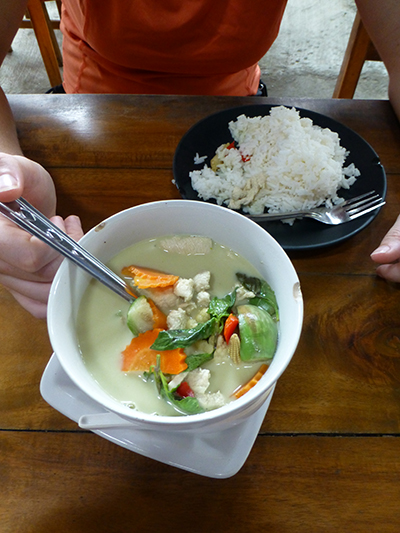
Delicious green curry served at Yam Yam Restaurant. Ran us 80 Baht ($2.50). It was so good we splurged.

Delicious green curry served at Yam Yam Restaurant. Ran us 80 Baht ($2.50). It was so good we splurged.

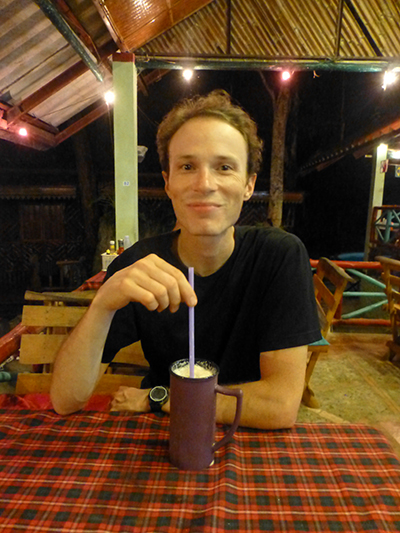
Me enjoying a fruit lassi (fruit and yogurt drink) at Rapala Restaurant.

Me enjoying a fruit lassi (fruit and yogurt drink) at Rapala Restaurant.

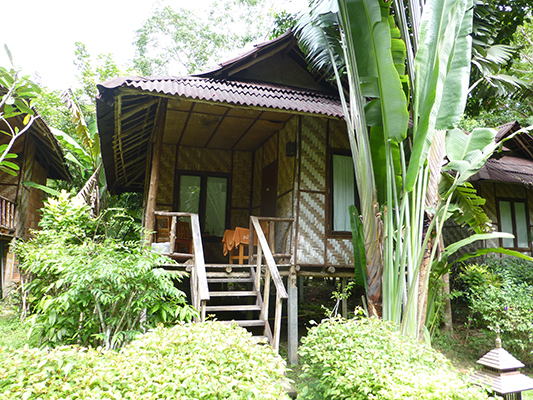
Our bungalow.

Our bungalow.

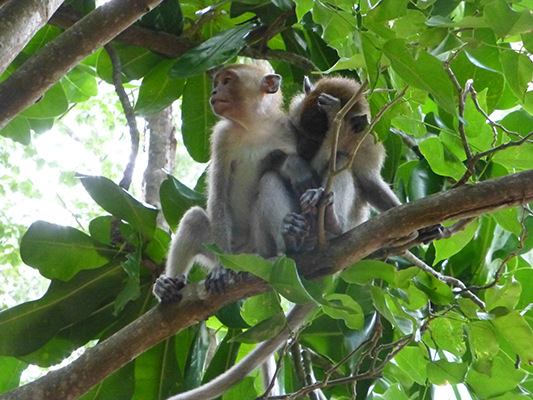
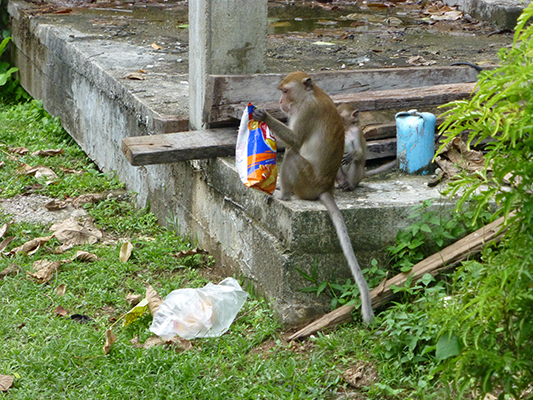
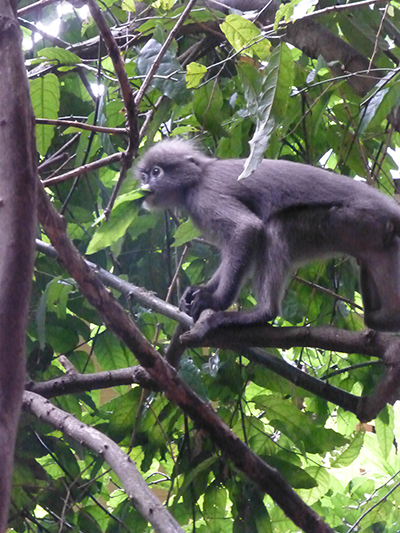
Railay also has a family of both Macaque and Langur monkeys. The Langurs were pretty chill, seldom seen and stuck to eating leaves. Macaques on the other hand were always making a showing on some part of the island, typically where they had easiest access to food. We witnessed, on a couple occasions, them stealing food from unsuspecting tourists. Anyone carrying a bag that was obviously filled with food was a potential victim of the Macaques. They simply walk straight over to the person and take the bag out of their hand before they know what hit them. It’s really pretty funny. The victims usually found it humorous as well. When’s the last they had a monkey steal their lunch?

Cute little Macaque monkeys.

Cute little Macaque monkeys.

Not so cute thieving Macaque monkey.

Not so cute, thieving Macaque monkey.

Langur monkey. He won't steal your food.

Langur monkey. He won’t steal your food.

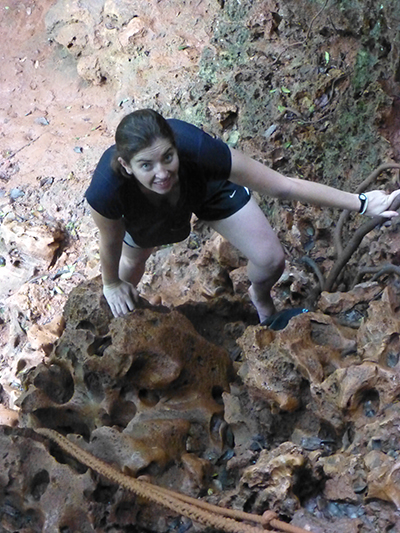
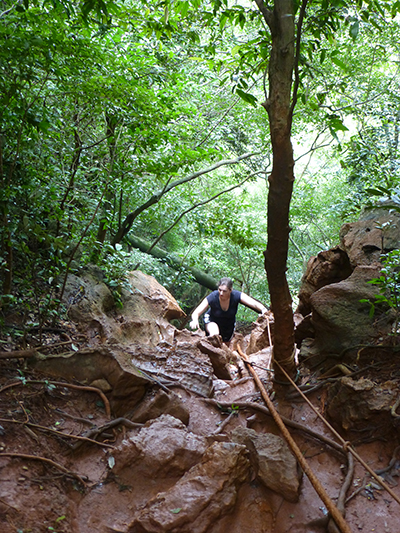
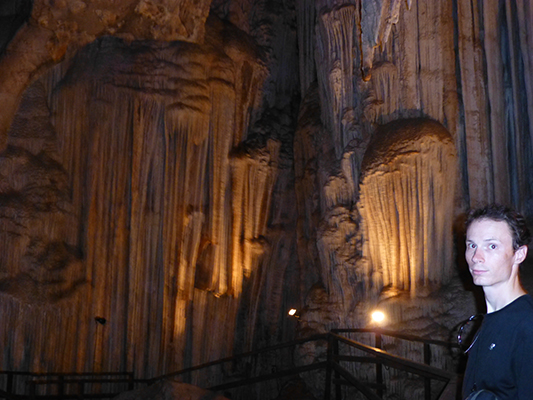
Our last full day in Railay was probably our busiest. I think we spent so much time relaxing that we crammed everything in on the last day. We finally decided to do a trek to a viewpoint on the island that yielded the photo at the top of this post. It also gave Sarah a few scratches and bruises (no surprise there…she’s a peach after all). It had rained heavily the day before, leaving the trail muddy and slippery. We also did the quick walking tour of a popular cave called Diamond Cave. It wasn’t anything spectacular but it was Sarah’s first caving experience.

Inside Diamond Cave

Inside Diamond Cave

Should of brought a climbing rope is what she's thinking.

Should of brought a climbing rope is what she’s thinking.

Finally to the top.

Finally to the top.

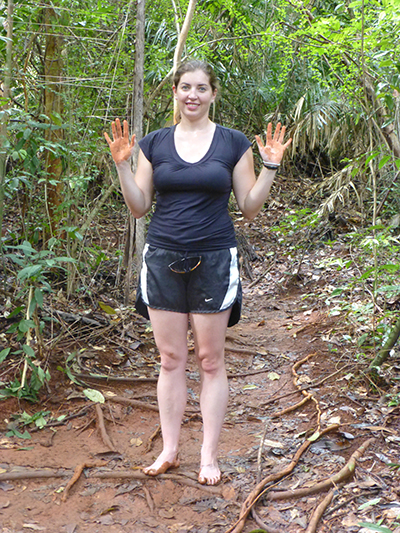
Still unscathed at this point. Only muddy hands. Later she ended up with a scrape and bruise on her knee. Bonus!

Still unscathed at this point. Only muddy hands. Later she ended up with a scrape and bruise on her knee. Bonus!

Diamond Cave.

Diamond Cave.

Diamond Cave

Diamond Cave

We finished the day off observing the Loy Krathong Festival. It’s a day each year that people of Thailand say thanks to/for the water for all that it provides. At least that’s the story we got. I think there’s more to it, though. People create small floats made of leaves and flowers and send them afloat in rivers, lakes and the ocean. Small translucent hot air balloons are also released into the night sky. To cap the celebration off, one of the local restaurants put on a fire show. We’d witnessed the same show our first night there but didn’t have the camera with us. Basically, a couple of guys perform tricks/routines with lit rods and chains to music. The show is pretty spectacular.

Some of the flower floats in the ocean.

Some of the flower floats in the ocean.

Hot air balloon let loose. This night was particularly windy, making it difficult to light the balloons and causing a few failures.

Hot air balloon let loose. This night was particularly windy, making it difficult to light the balloons and causing a few failures.

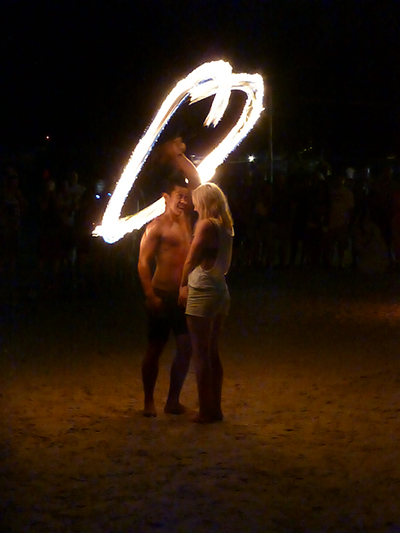
The fire brothers performing together.

The fire brothers performing together.

Awhhh, look at that. It's a heart. Every show they pull in a "volunteer" to twirl fire around their head.

Awhhh, look at that. It’s a heart. Every show they pull in a “volunteer” to twirl fire around their head.

This guy had a shaft lit at both ends.

This guy had a shaft lit at both ends.

For the finale he lit a cigarette with the spinning inferno near his head.

For the finale he lit a cigarette with the spinning inferno near his head.

Railay was pretty good to us. Maybe we’ll make our way back in the future and partake in some of the world class climbing it has to offer.

Categories: South East Asia, Traveling | Tags: , , | 5 Comments

Bangkok, Thailand

Ahhhh…a sigh of relief from the chaos that was Myanmar.

Since we already bought our flights to India for Dec. 8th and we want to be in India and Nepal at certain times, we have about 3 weeks to spend in Thailand before we head out. Which gives us time to prepare for my families visit to Thailand come April or May.

The first chunk of time we decided to spend in Bangkok to recover and be close to a hospital if needed. This wasn’t mentioned in the last post because there was so much information already on Myanmar, but I had a fever of 101.6 for four days, severe headaches and joint and stomach pains. I didn’t get a rash, but all of those are symptoms of Dengue Fever or who knows what else.

When we arrived in Bangkok I was feeling a little better, no fever even though I still had headaches and exhaustion, so I decided not to go to the hospital. We’ll never actually know if I had The Dengue or not. But, I’m sure glad that’s over. I’ve never been so sick, so often then the 3-4 months we’ve been traveling. It’s a good reminder that travel is not fun all of time and there is no place like home.

While we were in Bangkok, we did do some interesting things.

  • The first is figuring out McDonald’s has 9 baht ($0.30) soft serve ice cream cones. What a good way to cool down in HOT Bangkok with ice cream. After we figured this out, we had them everyday. Maybe once we had them twice in one day (what?! we’re trying to fatten Dave up).

Yay! Cheap, good ice cream!

Dave with Ronald McDonald in Thailand.

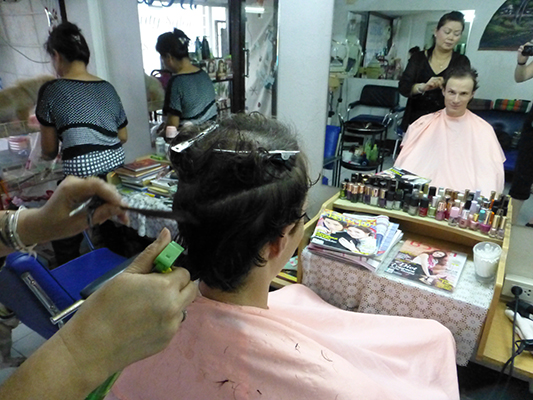
  • Dave finally got a haircut! It only cost 160 baht ($5.20) and it came out really great.

Looking good in pink.

Finished Product. Looking smexy.

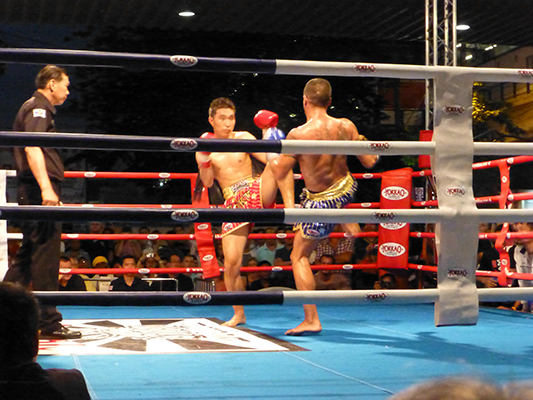
  • See Muay Thai Boxing for free

Dave ready for the fights.

Warming up the first fighter.

  • Eat lots of street food

This was breakfast. There were about 8 different sides you can choose from and two with a bowl of rice costs $1. We couldn’t beat the prices.

This was very good chicken noodle soup that cost $1. Dave ruined his with too much spice though.

  • Sell our Myanmar book in Banglamphu. Which is a very popular backpacking area and also VERY touristy with annoying tuk tuk drivers, over priced restaurants,  tattoo parlors, and lots of massage places. Not our place to be.
  • Thai iced tea with cookies

I got the Thai iced tea with cookies. Which sounds horrible and is on the first sip, but then you get used to it and love the little cookie crumbs.

  • Yummy dumplings!!!!
  • Cooling down in all of the crazy huge malls Bangkok has. Seriously there are 4-5 GIANT malls in one little area.

They had a new aquarium that they were promoting with this. We had fun with it.

Holiday spirit in 80 plus degree weather. It feels weird.

  • Crazy sidewalk clothes market. Worst idea ever. People are shopping and other people are annoyed behind them trying to walk.

Sidewalk madness.

  • Traffic, traffic and more traffic. Also, they drive on the left, which made crossing the street that much more difficult.

Lots of traffic.

  • Fresh fruit juice in the food court

Finally some fruit!

  • Overpriced drinks with live jazz music.

Dave enjoying his beer.

The band.

This is just fruit juice. And they tried to charge me $7 for this alcoholic drink with out alcohol.

It was a nice refreshing break.  I’m sure we’ll come back at some point in our travels.

Categories: Cities, South East Asia, Traveling | Tags: , , , , , | 1 Comment

Myanmar: Sorry we couldn’t stay longer

After our few week visit back home in the U.S., we decided to use the extra time we gained by leaving South America early to pay a visit to Myanmar (Burma). When discussing travel through Southeast Asia we had tossed around the idea of visiting the country but it had been pretty low on the list of countries to see in the area. The low placement wasn’t really based on much, because we honestly knew little about Myanmar. But what we did know wasn’t very good.

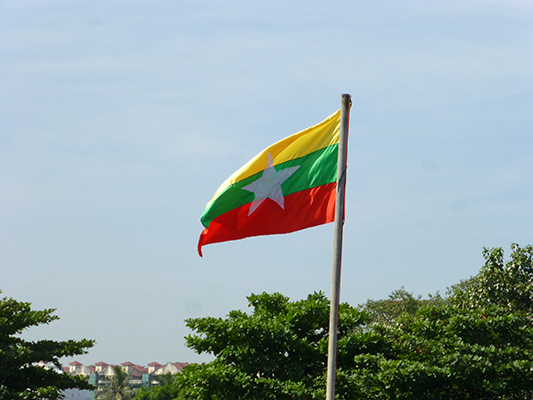
Myanmar flag flown in Yangon, the old capital city.

Myanmar, or Burma as it’s officially called by the U.S. government, has a pretty bad rap sheet for human rights violations over the past few decades and has only recently opened up to tourism. Don’t quote me on this, but I think it has the record for the longest consecutive years ruled by a military government, something around 50 years or so. Because of sanctions placed against the country for the government’s human rights violations it has been shut off from the rest of the world in a lot of ways. The guidebook we used (Lonely Planet) described it as not having changed much since its days as a British colony. It gained independence from England in 1947.

So we were pretty curious to see a place that supposedly hadn’t changed much in over 50 years and hasn’t seen tourism on a large scale for some time, if ever. We didn’t know what to expect. We did a little research online about Myanmar’s history and the logistics of entering and traveling the country and then we were off.

Through our research we found out pretty quickly that traveling in Myanmar wasn’t going to be as easy as we’d experienced in Central and South America, or what we knew about other parts of Southeast Asia. For example, there are no ATM’s so you have to carry all cash that you expect to need for your entire trip. The only place to exchange for Myanmar money (Kyat) is in Myanmar. One or two hotels in the major cities give cash advances on a credit card, but with a hefty percentage charged per transaction. No businesses excepts credit cards, save the aforementioned hotels, again, with the hefty fee. All U.S. cash that you bring to Myanmar has to be pristine and no older than 2006, and if it’s not, then you get a lower exchange rate or can’t exchange it at all. The bottom line is that there isn’t much in the way of infrastructure. All of this just added to our curiosity and desire to visit the country.

First things first, we needed a visa to enter the country. During our visit home we applied for and received our India visas in about a weeks time. That’s speedy. Not the case with Myanmar. We read that we should expect a visa for Myanmar to take up to 3 weeks. That’s a long time. So we searched and found a faster route. You can get a visa for Myanmar in as little as 1 day in Bangkok, Thailand. So that’s what we opted for. We flew to Bangkok, arrived at 6 am, applied for our visas at 9 am the same day, and then picked them up the next day. Done.

Cash was the other major challenge. Before leaving the U.S. we had to withdraw all of the cash we thought we’d need for our travels in Myanmar. Our plan was to travel for the entire length of the 28 day tourist visa. We roughly estimated what we’d need and then threw in a little extra for a buffer. Remember, there are no ATM’s. Unfortunately, we made one major mistake. We assumed that all banks carried crisp new bills all of the time. Nope. Wrong. They actually don’t like crisp new bills because they stick together and every once in a while a teller gives away free money. The only chance we had at new bills were the $20 bills in ATM’s.  ATM’s like new bills because they don’t jam the machine. So we spent several hours visiting about 6 banks on our last day in the U.S. trying to get the prettiest bills we could find in $100, $20, $10, $5, and $1 denominations. The only new bills we got were the twenties. Tellers at several of the banks were nice enough to look through there cash and pull out the best bills they could find. In the future it’d be best to inform our bank ahead of time so that they can order new bills. Whoops!

That’s not even close to all of the cash we had to carry.

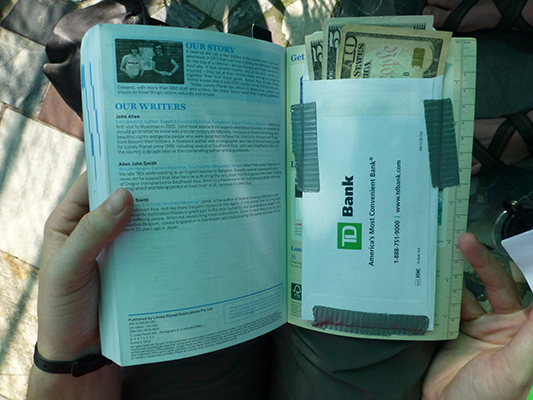
This is where we stored U.S. dollars that we planned to use during our day trips to keep it flat and in good shape.

The pristine bill thing turned out not to be a huge problem. We only had a bill rejected twice. Other times we slipped in the ugliest bills we had with a shiny, spanking new $20 and had no issues. We figure they’d be distracted by the $20 bill. You may be wondering why we needed smaller denomination bills if we were only exchanging for Myanmar money. Our research told us that some places only take U.S. money or at a minimum prefer it. I think this may be changing. Many places seemed to take U.S. dollars or Kyat. In the end the cash thing wasn’t a big issue. Though, it was a little unsettling carrying that much cash around. We got a taste of what it must have been like to travel in the “old days”.

As I mentioned, we planned to travel the entire length of the 28 day tourist visa. I mean, it’s a once in a lifetime experience to travel in a place like Myanmar at a time when it’s just opening up. While that’s true, we ran into a reoccurring issue that led us to decide to leave the country earlier than planned. One thing we didn’t expect, and hadn’t come across in our research, at least not until the last minute, was the trouble we’d have finding accommodations. While in Bangkok we decided to read some online reviews about hotels listed in our guidebook. In some of the recent Trip Advisor postings reviewers mentioned the trouble they had finding a hotel. Many of the hotels were either all booked up or charging an exorbitant amount of money for very basic accommodations. So we scrambled in our last day and a half in Bangkok to email several hotels to try to reserve a room before our arrival. Luckily, we found a place. They were charging $22 a night—the cheapest we could find and much more that we wanted to pay—for a room with a window and a fan. This price was about double of what was shown in the guidebook.

We stayed a couple of nights at the “White House” hotel in Yangon. Pretty pricey at $22/night for a hot box room on the 8th floor with a sliver of a window and small fan. They had an amazing breakfast though.

We found out right away that this was the case for much of Myanmar. Unlike with our travels in Central and South America, we had to book our rooms in advance. This was a challenge because nearly all of the hotels throughout Myanmar were fully booked. We spent hours making dozens of phone calls in every city we stayed in prior to moving on to the next city to try to reserve a room. To do this we had to use local pay phones (costly) with some dropped calls and some people simply hanging up on us because we couldn’t understand one another. When we couldn’t find a room we spent even more time changing our itinerary in a way that we thought might give us time to reserve a room in the next town. We heard of other travelers arriving in a town expecting to find a room, finding nothing, and having to sleep at a bus station.

The local phone booth. The people who run them are very helpful and patient. They dial the number for you and make sure it connects. It cost anywhere from 50 to 100 Kyat per minute. That’s about $.06 to $.12 per minute.

At one point we stumbled upon the “free” services offered by the Myanmar Travel and Tourism association. They called dozens of hotels for us in the next town and found us a room. We found out later that they tacked a $7 commission onto the cost of the room without telling us. Which led to us having to convince the owner to give us a room at the $25 value that we had paid. Needless to say, we found ourselves wasting a lot of time trying to find a place to sleep instead of experiencing all that Myanmar had to offer. In addition to time, we spent way more money for the rooms than we allotted in our budget. In the end we saw about a quarter of what we wanted to see and spent only 9 days in Myanmar.

The staff and Myanmar Travel and Tour association are very helpful but forget to mention that there service comes at a charge, sometimes. They helped us and many others for free, leading us to believe they were a service set up by the government to help deal with the trouble people had finding rooms.

We visited the old capital city of Yangon; the two small towns of Pyay and Magwe; the Buddhist temple strewn city of Bagan; and finally, Mandalay. We were also lucky enough to be at the airport on our way to Bangkok when President Obama visited Myanmar. In the short time that we were there we saw so much. Looking back through the photos to prepare this post I felt sad that we decided to leave. I don’t regret our decision, I just wish the circumstances were different. Myanmar is an amazing place. I feel blessed to have seen it before it has changed too much. I would love to return, but by the time I do I think it will be a totally different place. You can already see the change. The hotels are scrambling to try to keep up with the demand. As tourists flock to visit the country it will change to accommodate them. That’s not a bad thing at all. In fact, there are likely plenty of folks looking forward to the economic boost that comes with tourism.

My advice to anyone wanting to visit the country in the near future is to go in the off-season, i.e. not between November and February (check guidebooks to see what they describe as the busy season.) or book your hotels in advance. My guess is that finding accommodations in the off-season will not be as difficult and you might even have room to bargain. Also, do a bit of research to see what hotels are charging. There’s a good bit of price gouging happening right now, so the guidebook price estimates are way off. Don’t expect to get what you pay for either. Many of the budget hotels are in a sad state. That said, I’d recommend a visit. The people of Myanmar are fantastic and the country is beautiful.

This post is already too long so I won’t display the images one at a time. Below is a gallery containing all of the images. Our WordPress them doesn’t seem to allow us to create separate Galleries, so everything is together. Sorry for the mess. Hope you enjoy.


Categories: Architecture, Cities, Ruins, South East Asia, Traveling | Tags: , , , , , | 3 Comments

Change of Plans…this is why we are flexible.

For those of you who don’t know why we haven’t been posting the last few weeks is because we had to take a trip back home. My grandfather Pappy passed away and I needed to come back to be there with my family. We miss you every day Pappy.

Pappy at my brother’s wedding in July.

Needless to say, this is why we are flexible in our travelling plans. We were planning on spending another month and half in South America, but because we came back to the US, it didn’t make sense for us to go back down to South America for only a month and then fly across the world.

So we decided to move on. We’re currently in Bangkok, Thailand getting our visas for Myanmar. Myanmar’s internet access is limited and apparently going to be very slooow, so I wouldn’t expect any blogging until after Dec. 8th.

While we were home visiting, we got to spend a lot of time with family and friends. It was exciting to see everyone and catch up on everything that we missed in the 3 months we were gone.

Some exciting things we did in the US:

  • Dave got to drink a lot of Sam Adams Beer, both Octoberfest and winter lager – hopefully he got his fix for the next 9 months
  • Eat lots of Ice Cream (and fatten up)
  • Experience an Earthquake AND hurricane
  • Visit with friends and family

  • Go to the camp in Maine
  • Watched some episodes of “Here Comes Honey Boo Boo” – which made Dave cry from laughing so hard.
  • Vote
  • Go to the annual Halloween party

Can you guess what we were for Halloween?

Mammy even came this year!

I can’t believe we were home for three weeks. It went by so fast. But, It was a good break from the travel lifestyle and I can say that It was much harder to leave this time than it was the first time.

Here we go again.

Categories: Uncategorized | Tags: , | 7 Comments

Huaraz, Peru and the Cordillera Blanca Mountain Range

On a trip of this length it’s very easy to make plans only to break them later due to a variety of reasons, including anything from loving a place and wanting to stay longer or even sometimes hating a place and wanting to move on as soon as possible. So we decided early on that our plan was not to have a plan, but instead to choose countries or sections of a continent to visit and figure out the specifics as we traveled. One of the ways we decide where to go is by talking to other travelers. They’ve either done better research than we have or have already been to a place and can give you the thumbs up or down. That’s exactly how we decided to visit Huaraz, Peru. We came across more than a couple travelers that told us Huaraz, and more specifically the mountains surrounding it, were a must see.

Huaraz is considered a Mecca for outdoor enthusiasts. Near the city are the mountain ranges of the Cordillera Blanca and Cordillera Negra. These ranges have some of the highest mountains in the Andes, treks that rank in the top 5 or so in the Andes (maybe even the world), great rock climbing and ice climbing, mountain biking, and a myriad of other activities offered by the many guide agencies in town. So it’s easy to see why we were attracted to this area. An interesting little fact about the Cordillera Blanca mountains is that it’s home to the mountain featured in the movie Touching the Void, which is a true story about a climber that had to crawl down much a mountain with a broken leg after his partner cut their climbing rope and left him behind. You’ll have to watch the movie to get the full story.

So, without much planned we made our way to Huaraz. Unfortunately, during our day layover between Chachapoyas and Huaraz, in the beach town of Huanchaco, Sarah picked up a not so friendly bacteria from a plate of ceviche—a dish consisting of fish cooked only by the acidity of a lime. So the first few days in Huaraz were spent resting and recovering. The downside to that time was that cabin fever started to set in for me, but the upside was that our Canadian friends, Jon and Ariane, made their way to Huaraz, allowing us to hang out with them once again.

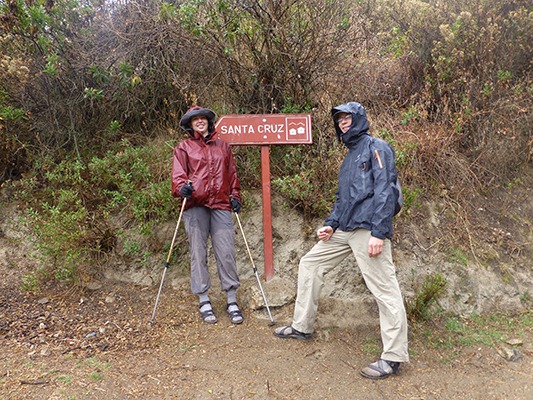
Our original plan was to do a well known trek called the “Huayhuash” trek. It ranges from 8-14 days in length, depending on the route you take and how much you’re willing to pay a guide agency. After asking around we found out that we missed the best season to do the Huayhuash trek. It was now the rainy season and that section of the Cordillera Blanca range is especially susceptible to the seasonal rain due to it’s location. Other sections, and consequently other treks, are better protected from the rain and were therefore a better option. One of the most popular treks is the Santa Cruz trek, 4 days and 3 nights in length. We opted for this trek due to the amount of time we’d already spent in Huaraz, the lower cost, the need for less technical gear, and the fact that Jon and Ariane were up for doing this trek as well.

We spent a couple more days acclimating to the higher elevation and taking in all that was the city of Huaraz. And due to nationwide teacher protests in Peru our trek was delayed one more day. The jury is out on whether the trek was really delayed as a result of the protests. We found out that our guide agency wasn’t completely honest with us on a few accounts. This seems to be a common practice in Huaraz, likely due to the low profit margins and abundance of guide agencies competing for clients. Sarah and I made the best of the added day and took a guided rock climbing trip.

Below our many photos from out time there.

Photos in and around Huaraz:

P1030751

Most of the corn we’ve seen so far has massive corn kernels. It’s corn on steroids. Really it’s just a different type of corn we don’t see in the states.

P1030765

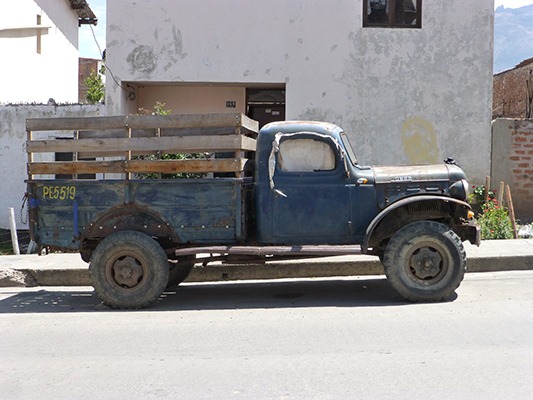
We seen many only model U.S. cars through South America. Here’s and old Dodge pickup that was parked near our hostel.

P1030767

This was an especially exciting day in Huaraz. While walking through town we stumbled upon a clash between police and the protesters. Minutes before this photo was taken rocks were being thrown and the police and they in return were chasing down the people throwing the rocks. We had to run with the crowd in order to avoid being run over. Kind of scary and thrilling at the same time. For the most part, though, the protests we witnessed all over Peru were peaceful.

P1030779

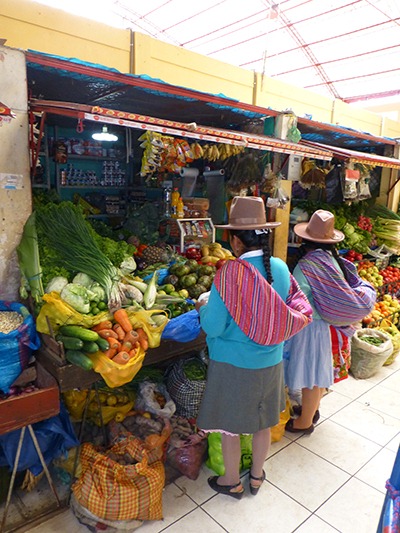
We saw women, and sometimes men, all over Peru dressed in traditional clothing. This photo was taken in the Huaraz market. The hats these women wear are really cool.

P1030781

Also at the market we saw Cuyes (Guinea Pigs). They’re eaten all over Peru. We’ve yet to sample any.

P1030793

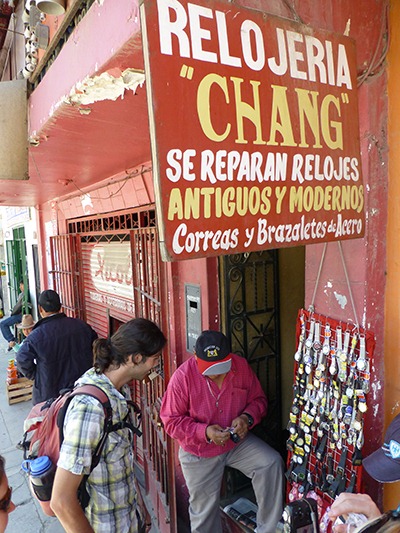
One of the cool things about countries like Peru is that you still see lots of things being fixed, as opposed to in the the U.S. where you simply buy a new version of whatever it is that broke. This is our friend Jon having his battery replaced. The watch failed to work a few days later though.

P1030800

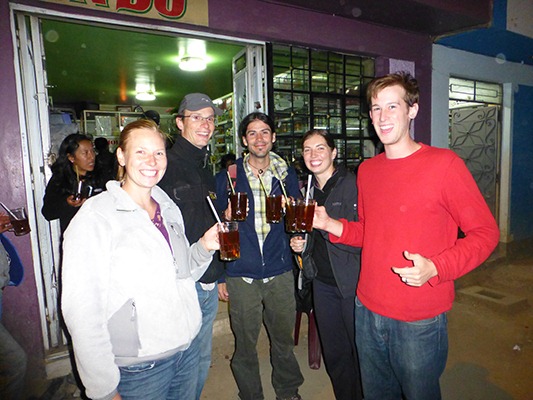
While in Huaraz we crossed paths with Erin and Zach, the couple from Seattle that we met at the farm in Ecuador. They are volunteering at an after school program in Huaraz for 3 months. They’re new group of friends introduced us to a local drink called Chuchuguasi, an alcoholic drink with supposed medicinal properties. It was cheap, costing around 40 cents, and strong.

P1030749

Me trying on an awesome hat/scarf combo at the artisan’s market.

P1030750

You see this hat worn around Peru by some of the men. It’s a wool felt cone.

Climbing near Huaraz:

P1030805

On our way to the climbing wall with our guide

P1030809

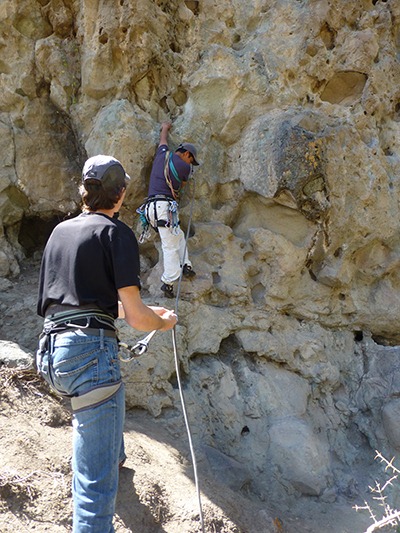
Sarah and I hadn’t climbed for a while and so we opted to have our guide lead the first route. Feel comfortable after the first climb, I led the next two. It felt really good to climb.

P1030815

Sarah climbing the first route of the day. Unfortunately, the guide service picked routes that were a little hard. Nonetheless it was still a good time.

P1030820

This had good pockets for hand holds but had a slight angle that made it challenging. Plus we were both out of climbing shape.

P1030836

The wall was on the outskirts of town in a small neighborhood. This was the view from the neighborhood.

Santa Cruz Trek:

Santa Cruz_Panoramic_03

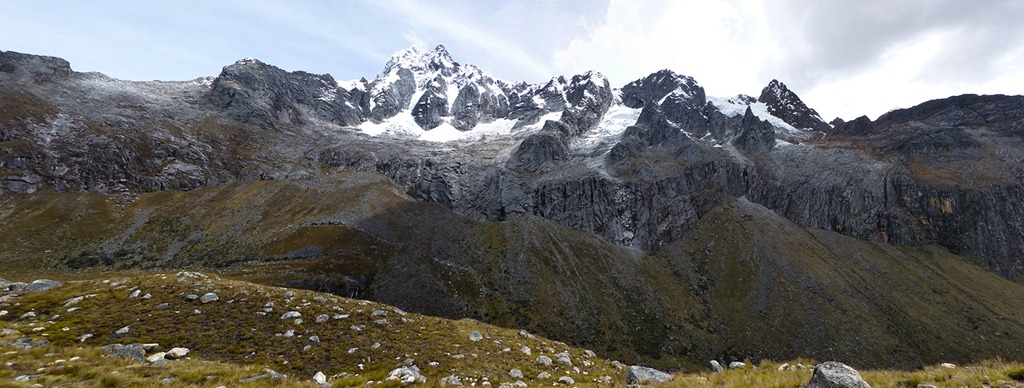
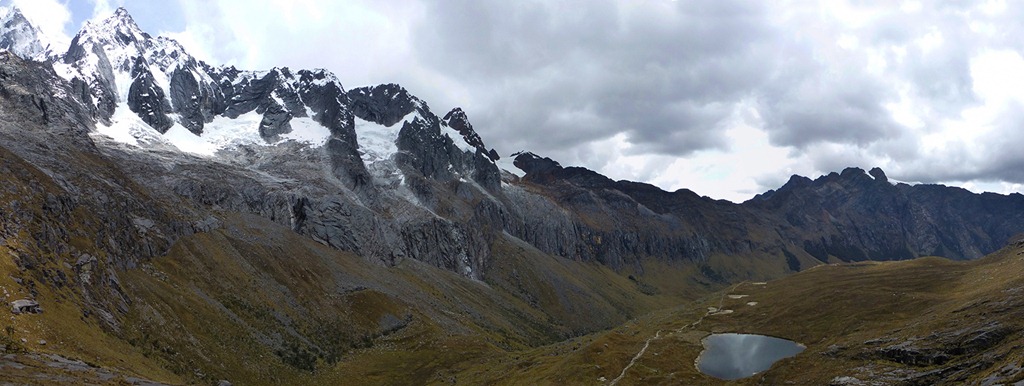
This is the view looking south (I think) on the second day of the Santa Cruz trek. We had just reached the highest point of the trek.

Day one of the trek started with a 5 hour colectivo ride from Huaraz to the trail head near a small town high in the mountains. We’ve ridden buses through a large portion of the Andes Mountains and I’m still fascinated by the farming that I see in this environment. All of the planting and harvesting is done by hand and cows are used for tilling. Some of the farms are located on very steep hillsides. There are usually grazing sheep scattered about as well. Unfortunately, we didn’t capture any photos along the way so you’ll have to use your imagination. We did manage to capture a couple photos had the highest point of the drive.

P1030850

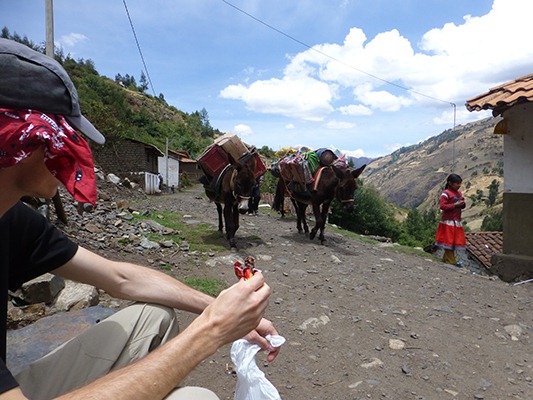
The drive to the starting point of the trek was very dust, hence the face mask.

P1030855

This view from the road got us really excited about the trek ahead.

After a long drive we finally arrived at the start of the trek in the Huascaran National Park. The last half of the day we hiked approximately 9 km to the first campsite. Even though we’d been in Huaraz for about a week at that point, we still found it difficult to catch our breath at the slightly higher elevations. I found myself having to catch my breath even when sitting. After the first day that wasn’t a problem.

P1030900

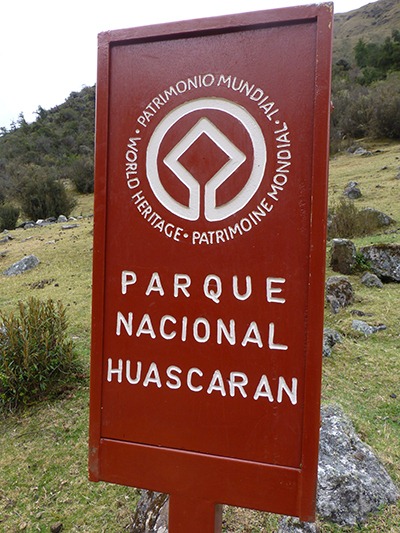
Huascaran National Park encompasses the Santa Cruz trek. It’s also the name of the highest peak in the park.

P1030860

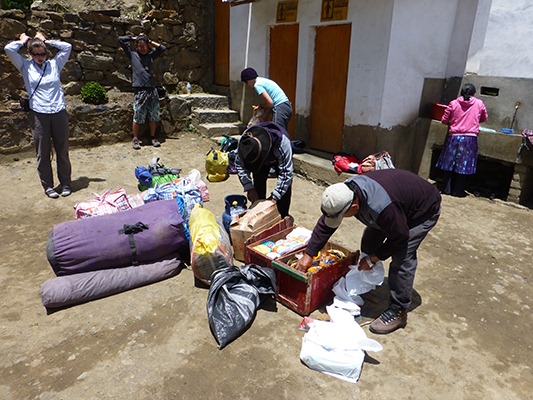
Our guide and donkey driver preparing the gear on the first day.

P1030875

These guys did all of the work.

P1030891

The first leg of the trek took us through some small farming communities. Here are some of the folks and their sheep that live near the park.

P1030893

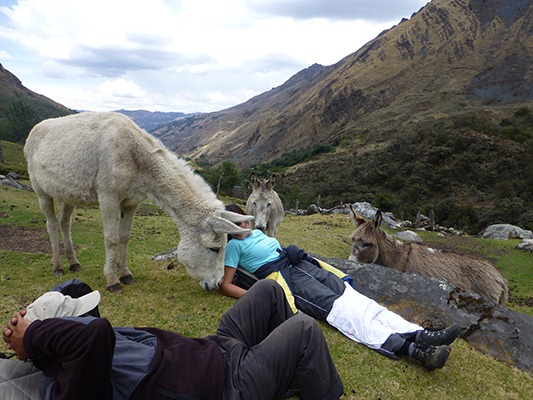
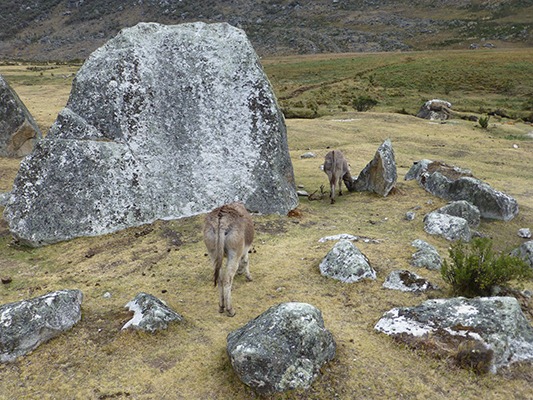
Very curios donkeys we encountered on the first day. He seemed so proud perched on his rock.

P1030899

It turns out that the donkey’s were very friendly, especially when they knew you had food. This guide stole a banana out of Angelic’s pack.

P1030909

As we hiked in the views got better and better. In the foreground is pasture land and you can see the glacier covered peaks in the distance.

P1030922

The first night’s campsite at 12,700 feet.

P1030924

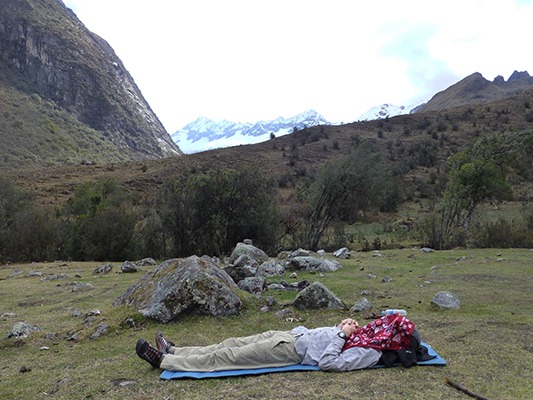
Soaking up the sun and taking a nap after the first hike.

P1030928

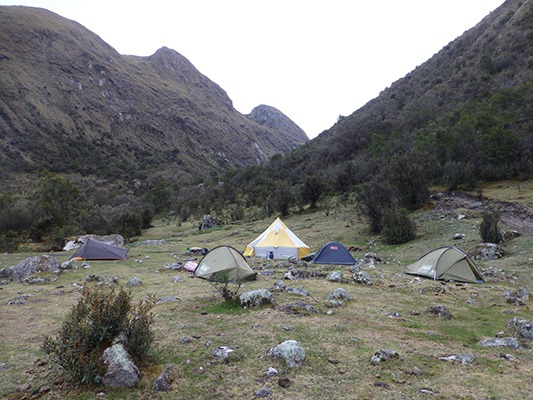
Out little tent city.

P1030932

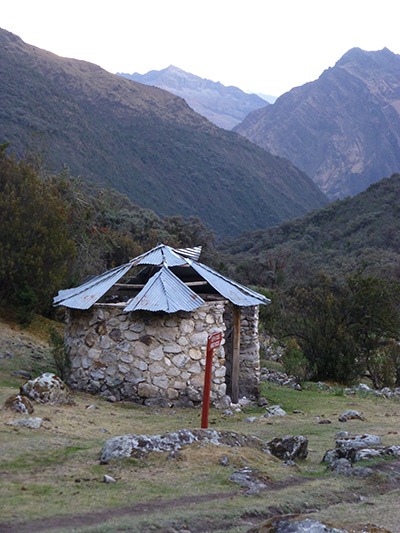
The outhouse was in rough shape inside and out.

P1030936

First course of the first night’s dinner, soup with a hard boiled egg. The dinners were delicious throughout the trek.

P1030939

Second course of rice, potatoes and chicken.

P1030940

Me sipping on some coca leaf tea to help with the altitude induced headache I had. This stuff really works. Also sporting my new wool Peruvian cap.

We woke early on the second day to get a jump on the longest day of the trek, at 18 km. The whole crew performed pretty well but I’m proud to say that Sarah and I seemed to be in the best shape of the bunch. It helps that we hand donkeys carrying nearly all of of the gear and the fact that we were sucking on coca leaves the entire time. This day saw the highest point of the trek at 4,750 meters. That’s the highest Sarah and I have ever been. It was very rewarding to reach the top, especially given that the good weather allowed for spectacular views. Over the next two days the weather degraded, so we were lucky to have good weather on the leg of the trek that offered the best views.

P1030942

The first day’s breakfast was the best, only because it included avocado. Every day after was only eggs, bread and jam.

P1030943

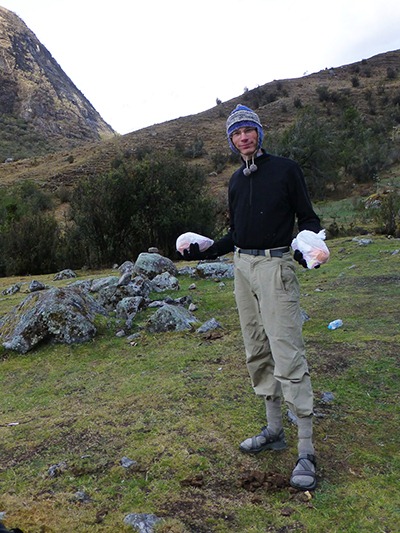
After much thought I decided that this was the best setup for hiking. Being so chilly at those elevations I opted to tuck in the pants to trap the heat. My sandals had more robust soles than my shoes so I went with them. It turned out to be a very good setup.

P1030957

The views just got better and better.

P1030958

Our guide, Juan, soaking it up. It being all of the goodness of the outdoors.

P1030972

We saw a lot of elevation change this day, so coca leaves were a must. Jon and Ariane fueling up.

P1030973

Sarah’s first time doing coca leaves.

P1030974

Green teeth are a clear sign of coca use.

P1040029

And more great views.

P1040030

According to our guide, this poor donkey was carrying too much weight, causing him to tip over.

P1040036

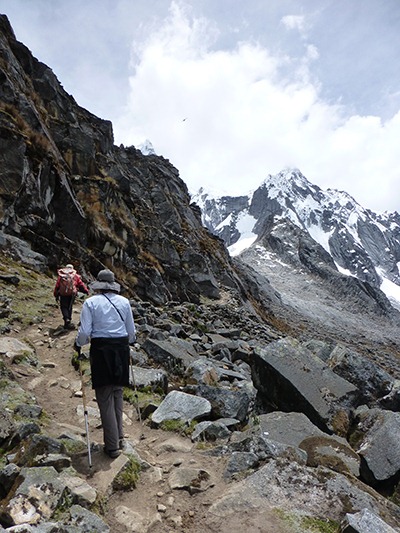
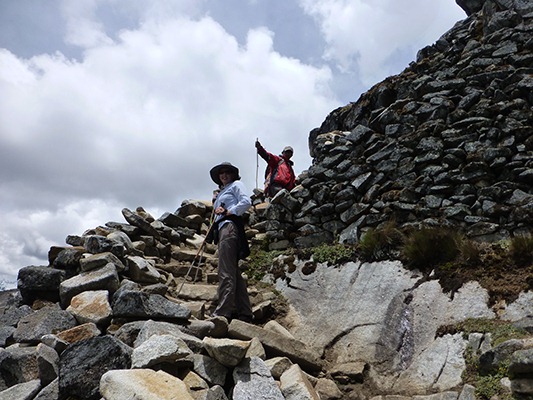
The stairs right before the summit.

P1040041

Punta Union was the highest point of our trek, at 15,580 feet. This is the highest Sarah and I had ever been. It was awesome.

P1040120

Posing with the crew at the summit. In order from left to right we have Jon, Ariane (French Canadians), Sarah, Dave, Angelic (England) and Do Ho (South Korea).

P1040135

The valley on the other side of Punta Union. Even more great views ahead.

P1040165

Happy to be going down hill.

P1040172

Sarah near the bottom of the second day’s hike.

P1040181

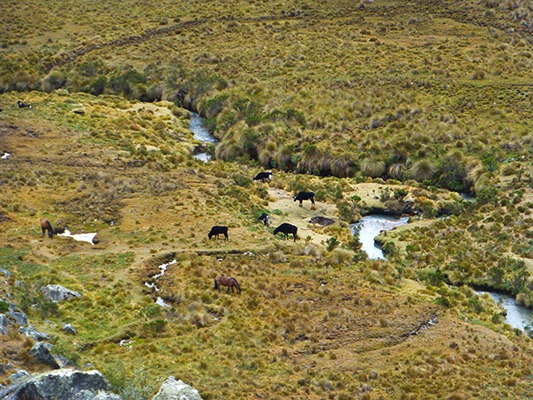
We saw lots of cows and horses grazing throughout the hike. Evidently some our wild and some our owned by people. I don’t know how they track them down. They’re miles and a day or more hike into some parts of the park.

P1040190

The second night’s campsite was just around the bend. This was the highest elevation we slept at. It was a little chilly.

P1040195

Jon almost to the campsite.

P1040196

River near our campsite.

P1040206

We arrived to a group of horses running through an open field. It was really cool to see the horses interact. They grazed near our campsite for the evening.

P1040220

Our asses taking a well deserved break.

P1040237

Awesome sunset of the first night.

The third day was a bit shorter than the previous day, coming in at round 12km. Most of the hike was down hill and flat, which was a welcome change from almost entirely uphill the day before. Our guide informed us that in February of this year a lake broke loose creating a landslide that traveled several miles down the valley we were hiking that day and deposited material in some areas up to 7 meters deep. It turned what used to be a lush, green valley floor, into a brown, dry, rock covered desert. We saw clear evidence of the extreme changes made to the environment by the landslide near our campsite and along much of the hike that day. Luckily no hikers were in the area at the time. Sadly, many horses, cows and donkeys were killed.

P1040239

We woke the next morning to snow on the ground.

P1040247

The valley we hiked through on the third day. All of the land in the foreground and the light brown section at the bottom of the valley is all of the debris carried by the land slide that occurred in February.

P1040248

More land slide damage.

P1040251

Our donkey’s hard at work again.

P1040263

This is better view of the debris deposited by the land slide on the valley floor.

P1040288

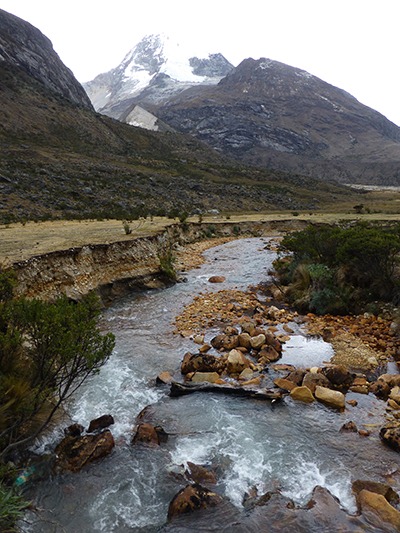
The glacier melt in some areas was crystal clear. I was almost tempted to drink it.

P1040301

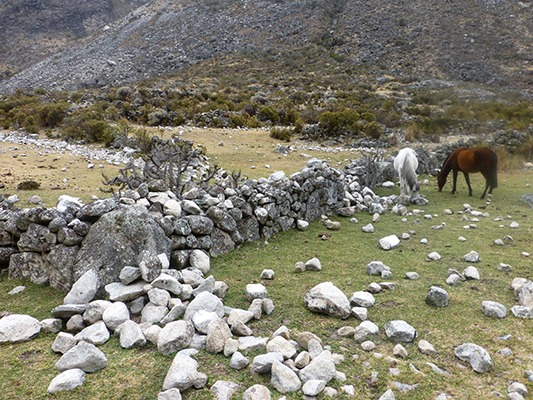
There were rock walls like this throughout the park. Before being designated a park, people farmed and raised livestock. These walls are very similar to those scattered all over New England.

P1040308

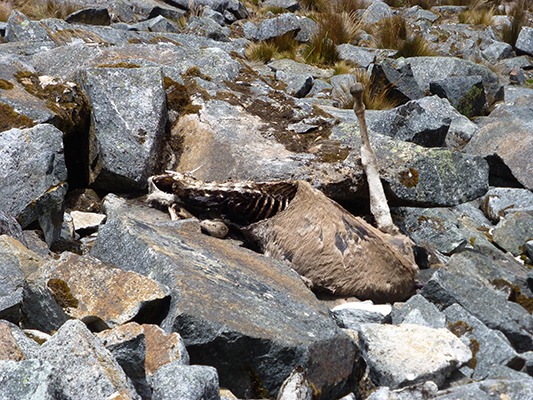
We came across quite a few bones.

P1040309

Getting a little closer to the third campsite.

P1040328

The plants changed as we descended. It became more and more desert like, with sand and some cacti appearing. This view reminds me of Yosemite a bit.

P1040333

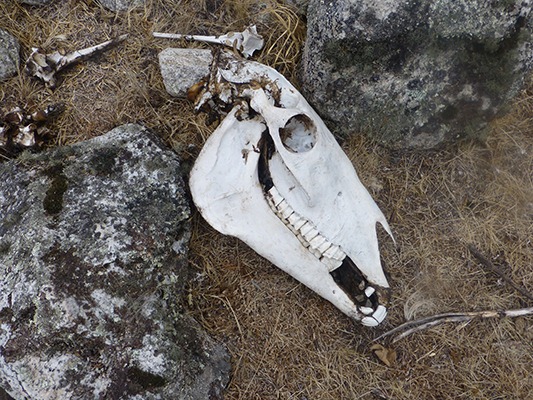
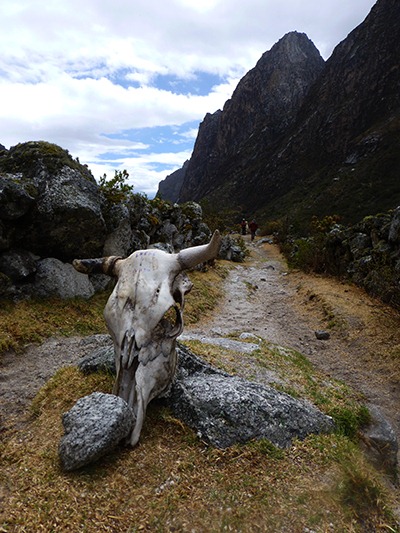
Someone propped this skull up on the trail. Kind of ominous.

P1040341

Sarah and Juan.

P1040344

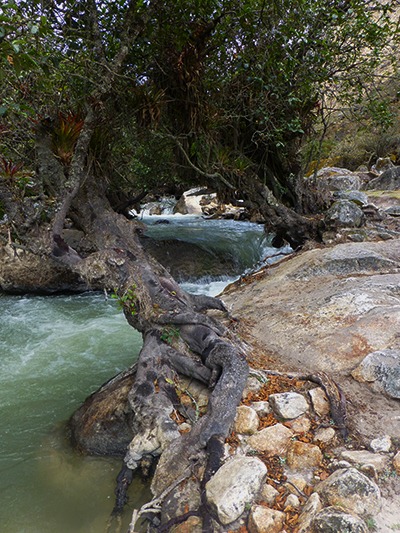
The river at this point was really flowing.

P1040357

The last campsite.

With the poor weather and swarms of biting insects at our campsite, everyone was in a hurry to get back to civilization. The last leg of the trek went by pretty quickly, only taking about 2 hours to finish. The trail followed the river that we had been following since the end of the second day. It was really cool to see the river grow to become larger and faster as we moved down stream. Much of the river is fed by glacier melt-water, and over the last two days of the trek, rain water. We ended the trek at the point that most tour companies start the trek. I’m not sure why we went the opposite way. Maybe to do more downhill than up.

P1040365

At the end of the hike. This is usually where most people start the hike.

P1040366

This little guy greeted us at the end.

This section of the Andes is amazing and by far my favorite of what we’ve experienced thus far. We hope to return to the Cordillera Blanca region in the future to do follow through on our original plan to do the longer Huayhuash trek.

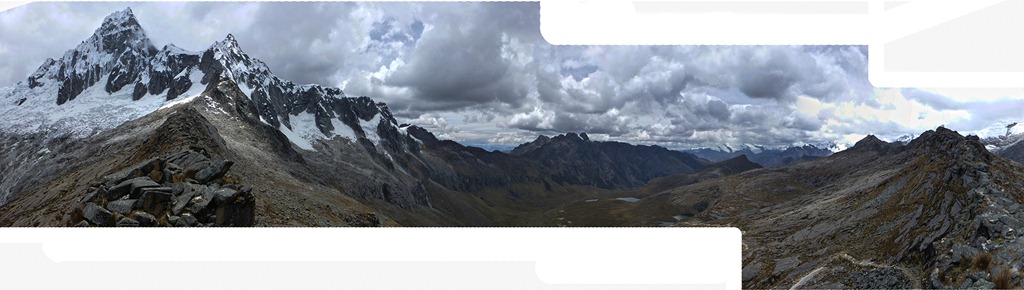
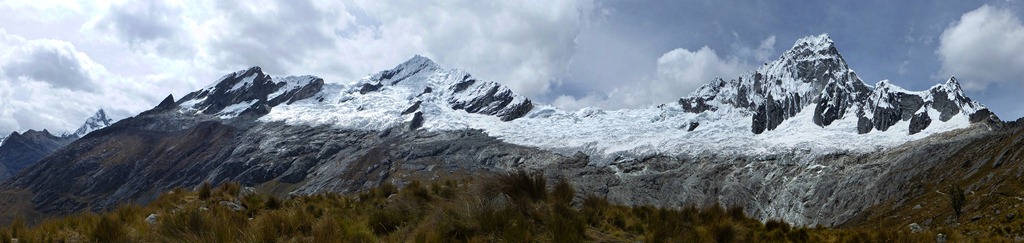
Along the way we took several panoramic shots. All but one of them stitched together well in Photoshop.

Santa Cruz_Panoramic_01

_

Santa Cruz_Panoramic_02

_

Santa Cruz_Panoramic_04

_

Santa Cruz_Panoramic_05

_

Santa Cruz_Panoramic_06

_

Categories: Nature, Outdoors, South America | Tags: , , , | 2 Comments

Hello Peru! Chachapoyas, Kuelap, and Gocta

Our trip from Ecuador to Peru was quite exhausting…

We had started our first of two days at 6 am in Vilcabamba, Ecuador. We coincidentally met up with a couple from Montreal Canada, Ariane and Jon, that we had met the day before. The four of us were all headed for the same border crossing into Peru. We opted for the less popular border crossing in La Balsa because it was closer to our first destination in Peru, Chachapoyas.

Our first mode of transportation was a 7 hour bus ride to Zumba Ecuador, then an open sided truck called Ranchero, for another 1.5 to La Balsa, Ecuador. We crossed very easily into Peru as we were the only ones. We took a Taxi from the border for another 1.5 to San Ignacio, Peru. After 12 hours of travel time, we had some beers and stayed the night in San Ignacio.

Dave and I in the Ranchero

Check out the massive security between Ecuador and Peru. It was crazy.

Our taxi ride from the border to San Ignacio with our new friends.

We thought we were getting some yummy dark beer finally. Turns out it’s really sweet. Oh well.

We woke up early the second day too and started with a tuk tuk ride to a colectivo, a 15 passenger van, to Jaen. Once we were in Jaen, we took another tuk tuk to a colectivo to Bagua Grande. Once there, we took our final colectivo to Chachapoyas. In total, the second day was 8-9 hours of travel.

Crammed into the back of the dusty colectivo. A nice peruvian couple did offer us some of their freshly cut pineapple. We couldn’t say no, it would have been rude. We survived, there were no bugs in the pineapple and it was tasty. Thanks again nice Peruvian couple!

Finally in Chachapoyas!

Chachapoyas was a hub for some of the local attractions. We decided to visit two of them. The first was a trip to the pre-Inca civilization of the Chachapoyas people called Kuelap. It was quicker to get there if you booked it through a tour, so we did.

One the way to Kuelap we stopped at another pre-Inca civilization site that was build on the side of a mountain face. There were estimated to be about 200 people living on this cliff. Not sure how they did it or how they got from house to house.

A little hard to see the actual rock walls, but they are there on the side of this mountain.

Close up of the rock walls they build on the side of the mountain for their houses.

Kuelap fortress was recently rediscovered in 2006 and is on top of a mountain at 9,842 ft high in the cloud forest.

Kuelap park  entrance

It was originally built by the Chachapoyas people and was estimated to house anywhere from 2400-4000 people as it has 400 round house structures. To put it into comparison, Machu Picchu is estimated to house 200-300, if I remember correctly.

Map showing the layout of the round house structures that were found inside the Kuelap Fortress.

Kuelap was eventually invaded and taken over by the  Inca and then several decades later, the Spanish and Chachapoyas people worked together to reclaim Kuelap Fortress.  It was determined to be pre-Inca as all the structures are round and Incas always build things in squares. Here are many great pictures from the site.

This wall surrounds the fortress and can get up to 19 meters (62 ft) high. The fortress is about 600 meters (1,968 ft) long and 110 meters (361 ft) wide.

Entrance #1 into the fortress. It might be a little hard to see, but they started out wide and then got narrower as it got closer to the entrance for safety reasons.

Top view on entrance #1.

View from above entrance #3, this shot does a good job showing how high up this city was.

The tight squeeze up to the second level where the most important people lived.

Human remains were found in the walls of some of the buildings.

Dave and I standing next to the reconstructed building to show what they looked.

The three sideways diamonds represent the earth, sea, and air.

A face carved into the highest structure.

Dave with the cloud abyss behind him.

One of the densely population sections of Kuelap.

The second attraction we decided to go see was the Gocta waterfall. The waterfall has two falls with a total height of 771 meters (2,530 ft). If you talk to the local tour guides, they’ll say it’s the third tallest in the world, but if you google it, it’s actually the 16th tallest. Still, pictures doesn’t do it justice, this is a tall waterfall.

The view from the road towards the waterfall.

Dave in front of the falls trying to get some perspective on size. Also, note Dave’s facial hair.

It was a 3 mile hike through the Andes Mountains and through some farms near the village. This trail and some of the roads to the village were not there prior to 2005. Before these were created it was a 4-day trek to go see the waterfall. I’m glad these were constructed when we were visiting.

Trail along the mountains towards the waterfall.

This section was a little scary because there was loose rock and a steep fall to the river below.

A small section was very jungle like.

Overall the waterfall was very beautiful and a lot prettier than we thought it was going to be.

Getting close enough that you can’t see the first of the two waterfalls.

Dave and I and Ariane and Jon at the bottom of the falls.

It’s hard to show just how tall it actually is.

Categories: Nature, South America, Traveling | Tags: , , , , , , , , , | 2 Comments

Vilcabamba, Ecuador: good food, fireworks and horseback riding

Vilcabamba is in the southern part of Ecuador, and though it’s considered a standard stop on the gringo circuit, we figured we’d stop by to see what it was all about on our way south to Peru. Just as with Cuenca, Vilcabamba is attracting a lot of folks from the U.S. and other wealthy first world countries looking to relocate and potentially retire outside of their home countries (they’re attracted by a lower cost of living, the fact that Ecuador uses U.S. currency and potentially a more relaxed and slower pace of life). Knowing this ahead of time we assumed that Vilcabamba would have the same vibe and be of a similar scale to Cuenca. Suffice to say, our assumptions were wrong. It’s a much smaller town and not nearly as developed as Cuenca. That’s not a bad thing at all, just not what we expected.

We arrived late in the day and didn’t have much time to search for a hostel before sunset. We don’t like walking around a city we don’t know in the dark. So we typically try to arrive early enough as to give ourselves time to find an affordable place to stay. Given that it was late and darkness was quickly approaching, we stuck closely to the guidebook’s recommendations and only checked out three hostels. The first was all booked up; the second was nice but a little pricey; and the third was weird, i.e. no one was staying there and there was at least one room that looked like a sketchy operating room. So we settled on the second hostel, prearranging to switch to a less expensive room the next day. The hostel was called “ Rendezvous” and was appropriately owned and operated by a French man in his forties. One thing that made paying a little more than usual for our room was that breakfast was included. That was a first for us during our travels. Though this seems to be commonplace for hostels in Vilcabamba we definitely saw it as a treat. It was a quality meal on top of that, including fresh fruit or eggs, homemade bread with butter and jam, fresh squeezed juice, and coffee or hot chocolate.

The hostel we stayed at in Vilcabamba.

Being that it’s a popular place for wealthy U.S. citizens to relocate, things are a bit more expensive in Vilcabamba. So for dinner the first night we went to a place close to the hostel and each got the soup of the day and shared a plate of delicious nachos. After a little exploring the next day we were able to find a great restaurant with very good prices. The tactic for finding decent food at a good price is to walk around town looking for the place that the locals eat. Since they’re most likely earning wages that are more in line with the cost of living, the chance is good that wherever they choose to eat is more affordable. And affordable for them usually means affordable for us.

Great restaurant in Vilcabamba serving Ecuadorian food at an affordable price.

The place we found was called “Katherine’s” and surprisingly it was located right outside of the main square where many of the most expensive restaurants were located. They had several lunch plates to choose from all costing $2.50 each. That’s a great price considering that lunch in Ecuador almost always consists of a bowl of soup, a main dish with rice, meat and sometimes veggies, and a juice. Being such a great deal we decided we could afford a lunch for each of us, as opposed to sharing a plate like the night before. To our surprise the lunch combo was more than enough food for one person. With the price, the portions and the quality food, we decide to eat lunch there the next day, but this time splitting the meal. That came out to $1.25 per person. That’s definitely our style.

Katherine’s restaurant soup. It’s more like a stew being that there’s a good food to broth ratio.

This was the second half of the meal, including rice, chicken, veggies and pasta, and a drink.

It’s also worth mentioning that part of the reason we like to save money on meals is so that we can enjoy some of the local sweets. I use the term “local” pretty loosely since many of the desserts we choose are things we can get back home. Either way it’s a nice indulgence. My favorite dessert yet has been the Tres Leches (Three Milks) cake we had in Vilcabamba. It was recommended by a fella from New York that’s been living in Vilcabamba for several months trying to decide whether to completely relocate and settle down. He was a wealthy businessman who grew tired of the corporate rat race, as he put it. Anyway, back to the cake. It was delicious, especially with a cup of quality coffee. What’s interesting is that though much of the quality coffee consumed in the U.S. might be grown in places like Ecuador, most of what’s served at restaurants is instant dissolvable coffee. This has been our experience thus far. So to get a good cup of joe is something to be excited about.

Tres Leches cake and a good cup of coffee for dessert.

One of the days we were exploring Vilcabamba we saw a handful of guys constructing some sort of bamboo structure in the main square. We’d seen a similar structure in one of the other towns we’d visited but didn’t know what it was. After closer inspection we discovered that it was covered in fireworks. Seeing this we decide we had to be around for the show later that night. With a little questioning we figured out what time the show would start. So we made sure to arrive a little early to secure a good spot to observe. As with finding a good place to eat, we settled into a spot near where the locals were standing. Being the observant people that we are, we saw that the spot we chose was a little close to the bamboo tower of fireworks but decided to stay put anyway. This was partly due to the fact that it was raining and the spot was under cover, but also because standing so close to a burning tower of fireworks would never be allowed in the U.S. So this was our chance to live on the edge.

Bamboo tower strapped with fireworks, pre-show.

The tower seemed to be a pretty solid structure. And to verify this, the engineer in the foreground of the above photo, as well as some random old dudes from the town, gave it a shake test several times before the show. We thought for sure that the tower was going to crumble under the force with which these guys were shaking it. But I guess it’s better to have it fall apart at that time than when the fireworks are ignited and the whole town is standing within feet of the structure. This picture also shows how close we were to the structure. We soon found out just how bad of an idea that was.

The bamboo fireworks show in action.

The fireworks show from a safer vantage point.

The start of the fireworks show coincided with the end of an evening church service right next door. There was some sort of the connection between the show and the church service. We think having something to do with the celebration of a Saint. As soon as the first fireworks ignited, being the intelligent people that we are, we decided to relocate. I just remember Sarah squeezing my arm and nervously moving away from the tower. The photos above show our starting point and subsequent new location, behind the churchgoers.  Surprisingly, none of the nearby buildings that were showered with sparks during the show caught on fire. Sadly though, the grand finale, i.e. biggest fireworks spinney wheel at the top of the tower, did not ignite, likely due to the rain. Regardless of that, it was a pretty exciting show. Catholics in Ecuador know how to celebrate.

The next day, and our final full day in Vilcabamba, we decided to take a guided horseback riding trip with a company called Horses of Holger. Based on our past experiences with horseback riding in the U.S., neither of us was very excited about horseback riding. It typically involves walking on a horse in a line of horses and is usually a pretty tame experience. After doing a bit of research about trips in this area, particularly with Horses of Holger, we were enticed by exciting trails and great views in the Andes Mountains.

P1030241

The office of Horses of Holger. It was two blocks from our hostel.

The trip we chose involved riding horses from the town of Vilcabamba to the home of Holger and his family high in the Andes Mountains. The first leg of trip was about 1.5 to 2 hours climbing the steep and narrow trails to his house. Once there, we took about a 15 minute walk to the highest point of the property where we had a 360 degree view of the surrounding area. Much of the family land is used as pasture for cows and horses with some land devoted to farming crops like bananas and yuca. In total the family has 200 hectares of land. The time of year that we were there was pretty dry, with the rainy season about to start. So much of the land had a golden color but would soon change to a lush green.

P1030102

The horses lined up and ready to go.

P1030111

On our way up. Sarah’s second in line wearing the orange shirt.

P1030119

This is my second horseback riding trip in Latin America. Both times I was way too big for my horse. The horses are much bigger in the U.S. My pony’s name was Alta-ir, which literally translates to High-to go. Something to do with the stars.

P1030120

Sarah was a much better fit for her horse Hidalgo.

P1030134

Getting ready to start our hike up to the lookout.

P1030144

The view gets better as we climb higher. The air also gets thinner and breathing harder.

P1030159

This little guy followed us all the way up, sometimes catching a ride along the way.

P1030167

Sarah proudly standing at the summit.

P1030170

Sarah and I with our host Holger.

Holger Farm_Panoramic_01b

Panoramic from the lookout on Holger’s property. (click to enlarge)

After returning from the hike, Holger brewed the group some coffee from beans he’d grown on the farm. I spent a little time relaxing in his hammock in the front yard taking in the fresh crisp air while observing some of the animals living on the farm. His home and the land around it is a pretty amazing place. There’s no road to the house and the only way to get there is on foot or by horse.

P1030191

Holger lighting a fire to brew coffee for the riders. What a nice guy.

P1030193

There’s our friend again.

P1030199

Roosters sure are pretty. It’s that redeeming quality that allows us to put up with all of their cocka-doodle-doodling. It’s a rare day that we don’t hear a rooster in South America.

P1030204

Relaxing at Holger’s house with his friendly animal neighbors.

The last leg of the trip we retraced our path back to Vilcabamba. My favorite part of any horseback riding trip is getting the horses to run. Most of the time you’re on a narrow trail and so it’s difficult to find room to run. So I would make my horse stop long enough to put a gap between me in the horse in front of me. Once there was enough room I would signal the horse to run until we caught up with the other horses. The best opportunity to run came in the last 10 minutes of the ride. We took a slight detour at the end of the trip down a road under construction, providing a little more room for the horses to spread out. I took this as an opportunity to push my horse a little more and pass some of the other more timid horses and riders. Up until this point the fastest the horse would go was at a trot, which isn’t that fast and involves a lot of bouncing, and isn’t a full out run. After a bit of encouragement—tapping the horse on his side with the short length of rope attached to the reins—I was able to get the horse to run. Running with a horse is so much smoother of a ride than trotting. The horse glides with only a slight jolt when his feet touch the ground. Being that we were so close to home the horses were more than willing to run because it meant getting us amateur riders off of their backs.

P1030218

Headed back down the mountain on the narrow trails.

P1030235

Almost home. I’m not sure what path the trip takes in the rainy season. This river bed was pretty wide in spots, indicating that it can get pretty full.

The horseback riding was definitely the highlight of our visit to Vilcabamba. I don’t think we were there long enough to see what some of the folks who decided to resettle there see in the town. For us, a few days was plenty enough.

Categories: Nature, South America, Traveling | Tags: , , , , , , | 4 Comments

A day hike in Cajas National Park

Dave and I wavered on paying a tour company to take us to Cajas National Park, but it was going to be about $40 each to do this. We did some research online and found that this park is one of the few in Ecuador that has some marked trails. We took a trip to the tourism office in Cuenca and they provided us with information on how to get there and assured us the trails were actually marked. So we decided to save some money and do it ourselves.

View from the park office at Cajas National Park.

How to get to Cajas National Park:

  • Take any bus from downtown Cuenca to south terminal, also called Feria Libre which is listed on the front of the bus. Bus Ride $0.25 each and about 15 minutes long. We started to look for a bus at 6:15-6:30 am.
  • Take any bus from Feria Libre headed to Guayaquil through Cajas. We confirmed with the bus driver and asked them to let us know when we were at the park office. Bus ride $2.00 each and about 30 minutes long. We arrived at Feria Libre at 6:45 am and the bus to Guayaquil came at about 7:20 am.
  • No entrance fee to Cajas and they provide you with a map. We decided to do trail #2.
  • After hiking, wait on the street for buses from Guayaquil to Cuenca to flag down. We were told they come every 30-40 minutes. Another $2.00 ride. Right as we got back to the office there was a bus coming down the road, we ran and caught it. The run was probably the hardest part of the day.
  • Once at Feria Libre, take any bus headed to downtown Cuenca. Another $0.25 ride.

Dave and I at the park entrance.
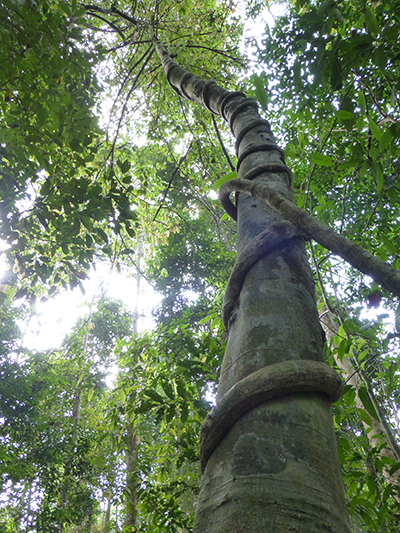
Once we were at the park, they provided us with a map, information on the weather (it was a really clear day and should be no fog/clouds), and provided guidance on which trail to take. We were told that trail #2 has better views but has higher elevation change than trail #1. We had decided before we came that we were going to do trail #1. We were easily persuaded with thought of better views and from the assurance we got from a couple, a Peruvian women and an Australian man, who also decided to do trail #2.
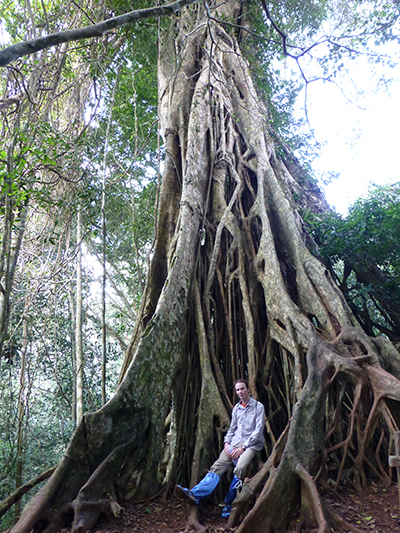
Trail #2 is green on the map we were provided.

The actual trail head is behind the lake. We took a clearly worn trail around the lake with some great views of the lake. One of my favorite shots came from around the lake.

One of the many good views from around the lake.

My favorite shot of the day.

While on this trail, we eventually caught up with the couple and started chatting. We got along so well that we ended up spending the day and night with them. Jake co-owns a guiding company in Riobamba and also started an eco-volunteer website for Ecuador called Ecuadorecovolunteer.org. His girlfriend, Natalia, works as a biologist in the Amazonian jungle. Both of them were very interesting people to talk and share the day with. Jake had a lot of useful information for us on where to hike in south america, people to contact, books to read, and movies to watch. We were both very fortunate and excited to have met them both.

The four of us took a little while to find the start of trail #2 and once we did we realized it went straight up a mountain side. Breathing was very hard because of the altitude and we took many breaks. There was also some spots were it was a little scary because the trail was very steep and the path was loose gravel.

Jake helping Natalia up the scariest part of the trail.

Taking a break to catch our breath and calm ourselves from the really steep section.

Almost to the top of the really steep section.

Pretty scenic trail to the top.

The views from the top were pretty spectacular and you had a full 360 degree view. The mountains in Ecuador are huge. This peak stood at 4,260 meters, which is 13,976 ft. This is the highest I’ve ever been!

Soaking up the sun and the views. It was also VERY quiet and peaceful.

Dave enjoying his peanut butter and banana sandwich and checking out the map. Of course.

The group, myself, Dave, Jake, Natalia, and two girls from Germany that we met up there.

The way down was also steep and required some technique, for me anyway. The technique was to grab the dry, very strong grass and then slowly take a step. It worked, I’m here to talk about it uninjured. I think we also got off trail at the bottom of the mountains. There were many unmarked trails that lead back to the lake and we followed one of them. It worked out, but I don’t believe we did the full #2 trail.

Perfect technique.

I want to point out how amazed I was at how Natalia hiked the whole trail in dress boots. She was also amazed but said she’d never do it again.

I think this one portrays how big the mountains are.

After a day full of hiking with awesome views and meeting some great people, we saved ourselves $71 to top it all off. This was by far one of the best days of our trip. Below are some more pictures of the day. Click on the images to see a larger version.

It is really rare to see forest above 4,000 meters, but in Cajas they have the quinua forest which is shown behind Dave. They were mostly in the shadows behind big peaks.

Very interesting plant that grew through the spongy like plants. You can see the water it’s holding.

Dave on the trail around the lake.

Very spiky plant that grew throughout the park.

Another panoramic of the park.

Categories: Nature, South America, Traveling | Tags: , , , , , | 6 Comments

Blog at WordPress.com.